
The Challenge in Growing Natural Forests

An eight-foot high fence splits this forest neatly in half. But what’s the other difference between the forest on the left and the forest on the right? The answer is deer browse. An explosion in deer numbers and their voracious browsing habitats devastate the natural regeneration of forests. Deer now represent the main threat to the long-term viability of Irish native woodlands according to foresters and ecologists. The Government recently held a public consultation on this very issue. These nimble and often reclusive mammals nibble their way through huge quantities of young saplings- mature trees are generally unimpacted but it’s the next generation of young trees (as well as ground flora) that are decimated. It’s worth noting that Sitka and Norway spruce which dominate Irish plantation forestry are unaffected by deer browsing. But no one wants a landscape dominated by non-native conifers so a solution is needed.

Sheep and wild goats (in parts of Munster) are also guilty of similar browsing habits
on unfenced forests and commonages but it’s the uncontrolled nature of deer that
make them an even greater challenge. So why are deer numbers increasing so
rapidly? In essence the Irish ecosystem is out of sync and there are no natural
predators (such as wolves) to limit deer spread. The second reason is that there are
fewer deer hunters than there were in the past. Unfortunately, the landed gentry
introduced non-native deer species to enhance their recreational hunting options and
this has further exacerbated the problem as these new breeds are among the most
prolific. Finally, as the area of land covered by forestry has increased in Ireland, deer
now find themselves with a greater area of sanctuary where they can breed in relative
safety.
Protective tubes can be somewhat effective to protect the lower branches of planted
saplings but don’t forget a forest is more than trees. A healthy forest has a wide range
of understory shrubs, ferns and grasses which give habitat for mammals and insects
and deer will decimate these plants too. Alternatively, fencing of forests to keep deer
out is an expensive option. Fences in forests are notoriously difficult to maintain and
indeed the strength of large stags is often enough to breach the strongest fence.
Winter storms knock branches and trees and these often damage sections of fencing.
That said one man who used fencing to great effect was the acclaimed writer,
Eoghan Daltun who wrote the widely acclaimed book, ‘An Irish Atlantic Rainforest’
about how he transformed a dying Atlantic Rainforest into a thriving ecosystem.
However, fencing the entire landscape is not a realistic option. So in response to the
deer threat in Germany, a phrase developed which translates roughly as: “Trees need
lead and light”. The lead in this case refers to bullets. Regular culling of deer numbers
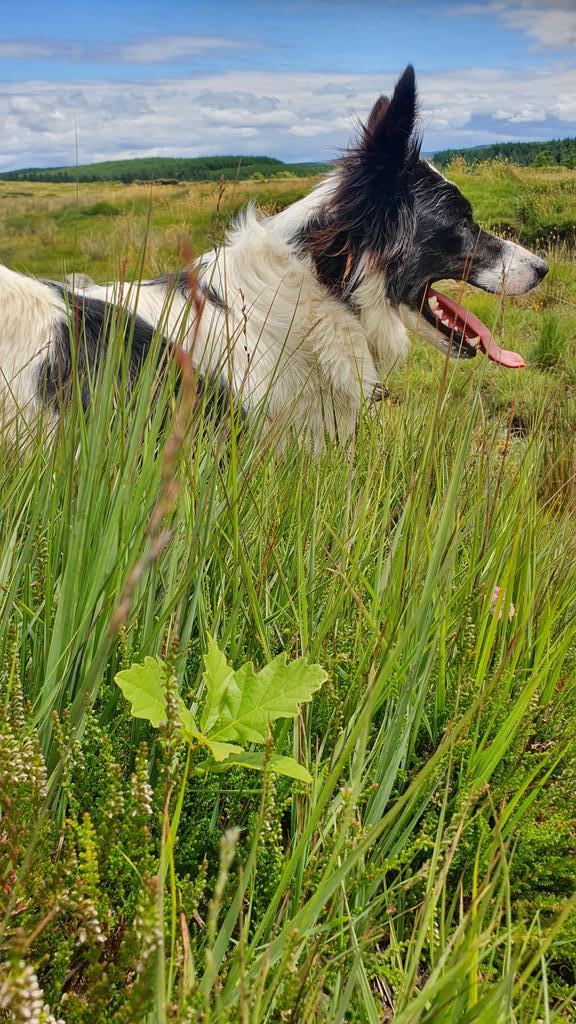
keeps numbers at a low enough level to allow forests to regrow. In the picture above,
Shep is guarding a little delicate oak sapling which has popped up in the foreground.
Natural regeneration is natures way, and the cheapest way to grow trees.
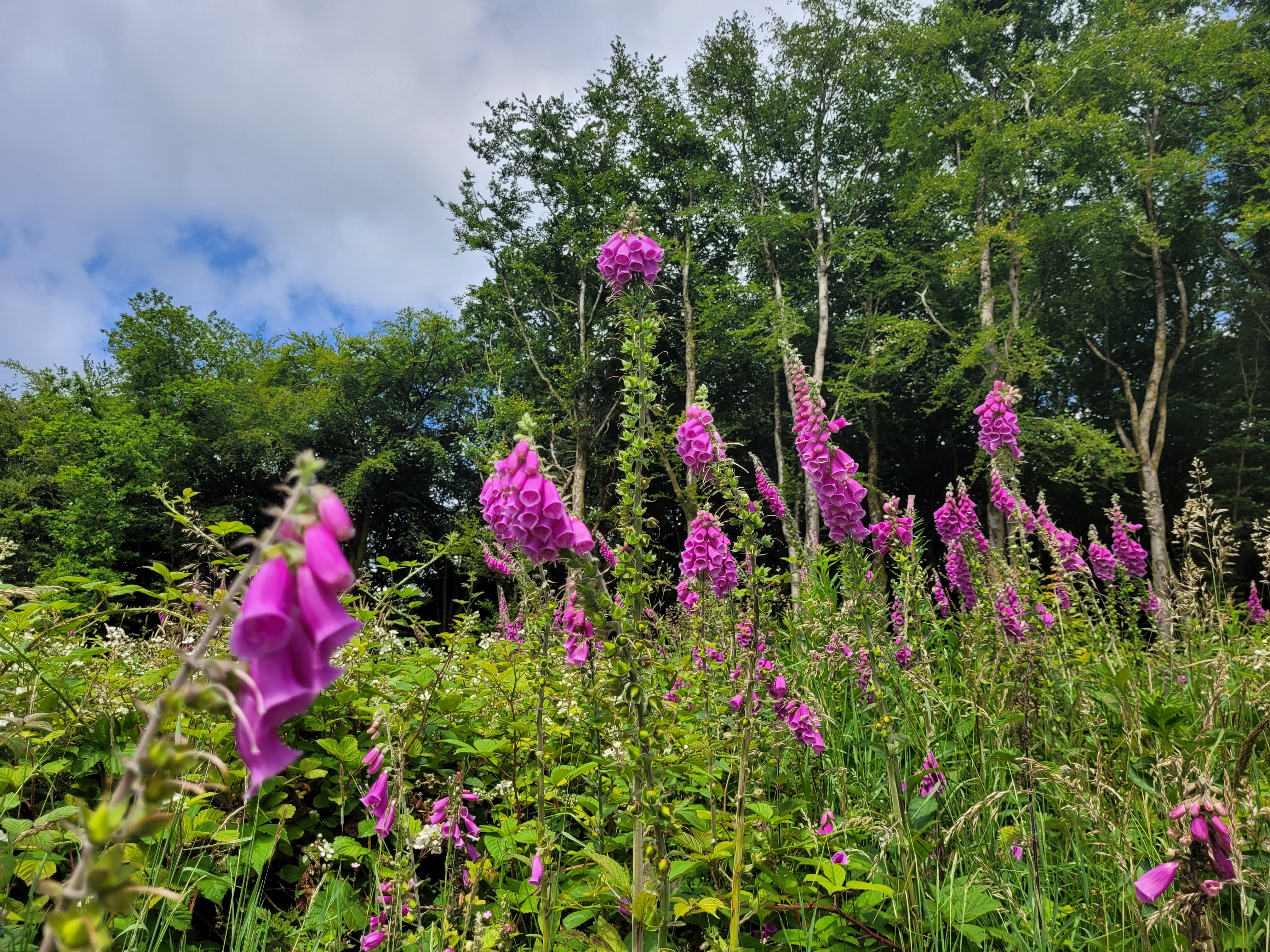
In the above picture, a recently cleared forest gives way to a profusion of wild native
flowers such as foxglove. High deer numbers threaten both these and young trees,
both planted and naturally regenerating. Critically the public want more and more
broadleaf forests and more forests to be managed using less clearfell and more
continuous cover forestry (CCF). The success of CCF relies hugely on the natural
regeneration of trees (as opposed to human planting of trees). So for CCF and
natural forestry to work deer numbers need addressing. Management not eradication
is required. For example in Baronscourt Co Tyrone where CCF is being practised,
estate managers use heat sensing drones to enable accurate counting of deer
numbers across vast landscapes. They can then set their “cull” level to keep deer
numbers in check.
 Transition Monaghan