
On Saturday last the re-enactment of the Fair Day in Castleblayney recalled memories of Fair Days in the small towns of rural Ireland. MEG member Liam Murtagh went along to the ‘Castleblayney 400’ event and saw a range of produce, crafts, services, games and working farm machinery from bygone days on display. He now reflects on the importance of the production and use of local food produce into the future.
The Fair Day which was held in glorious sunshine in Castleblayney on Saturday last brought an air of enjoyment and excitement to the town. It was a welcome development in what has been challenging times for both businesses and for many residents. For some it was tinged with some nostalgia as they remembered the Fair Days of the 1960s.
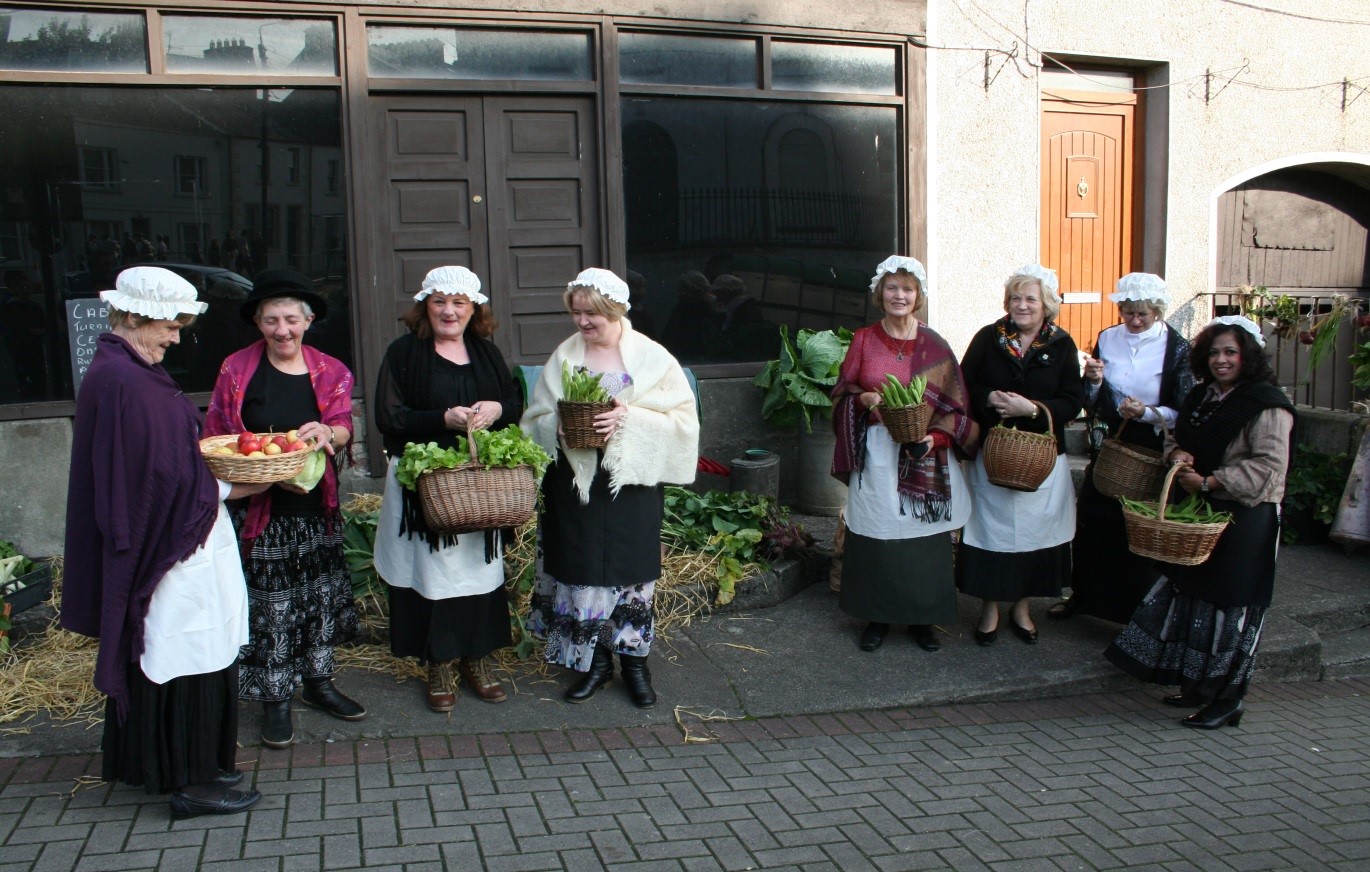
Pictured at the ‘Fair Day’ in Castleblayney were some members of Castleblayney Community Gardeners along with a customer. The fruit and vegetables on display were grown in town’s community gardens or locally.
On the Fair Day in Castleblayney up to the 1960s most of the food produce on sale on the street or in the shops came from the surrounding parishes. It was usually transported to the town by horse and cart and so virtually no oil or other fossil fuels were used in the growing and transporting of the produce. The work of growing crops involved long hours of physical toil on the land – tilling the land with horses and often working in adverse weather conditions. It was ‘organic food’ but such a term was not used in those days. In the case of my own family, we cooperated with our neighbours at busy times such as at the digging of the potatoes and saving hay. Incomes were small and erratic and emigration was commonplace.
In the years since the 1960’s there has been a transformation in the way we grow and buy our food. The number of farmers who grow vegetables for sale or even for their own use is very few. While there are some Irish growers, much of our food travels thousands of kilometres. Enormous amounts of oil are used to grow and transport both the food we grow here in Ireland and the food we import. The flavour of food that travels long distance is often of doubtful quality. I find that the carrots or plums I pick from my own garden are always far superior to those on the supermarket shelves.
On the way home from the Fair Day I purchased a daily newspaper. The main headline read: ‘Human Influence on climate change a ‘clarion call’ to global community’. On the previous day, the latest report from the UN’s climate scientists had been published and there was in-depth coverage throughout the media. The challenge of climate change that faces the next generations will be enormous – many say now that it is not a question of averting climate change, it is a matter slowing its progress and allowing humanity to adapt to it.
Summers in Ireland will be warmer and drier, winters will be wetter and milder and there will be an increase in the frequency of heavy rainfall events. While this might all seem tolerable, we need to consider that what happens internationally will have a major impact on Ireland. The ‘Stop Climate Chaos’ group claims that Ireland could face an influx of climate change refugees from countries that will be severely affected or even wiped out by rising sea levels.
The role of addressing climate change is one for the UN, for governments, corporations, communities and individuals. Reducing emissions of greenhouse gases by cutting down on using oil is the main way to addressing the problem. As there are considerable amounts of greenhouse gasses produced in the modern agri industry this is an urgent need to address the issue. As individuals we can choose to eat foods that have a low carbon / low food kilometres rating – the lowest would be for food gown in our garden! In Co Monaghan the GIY movement and various community gardens and allotments projects are playing a role in both awareness raising and growing some food locally. Farmers Markets and initiatives such as this weekend’s ‘Taste of Monaghan’ help the marketing and sale of local food. The amount of local produce in supermarkets varies a lot but we can keep reminding them that we would like to have more fresh local produce available.
At a community level in this county, Monaghan Ecological Group is seeking to harness the efforts of people here to undertake local climate change responses including awareness raising, skills sharing, and projects in the areas of local food, energy and currency – such as the LETS Trada one that was featured in a previous article.
For enquiries or comments please email monecogroup@gmail.com. Check out the Monaghan Ecological Group facebook page or website at http://monecogroup@wordpress.com

 Transition Monaghan