
Written by Dermot McNally
‘Be sure to take all your organic information with a pinch of salt.’
Farmers are among other things, business people – they produce product to sell, hopefully at a profit. So with this in mind Dermot McNally was puzzled as to why more farmers won’t consider switching to organics. The question occurred to him in his local supermarket. He noticed that the rasher (bacon) in his hand was imported from Denmark. Surely we can satisfy the market for rashers ourselves? No is the answer. Dermot investigates why…
Is there a shortage of pigs in Ireland? Ha! Not a chance! We’ve about 1.3 million pigs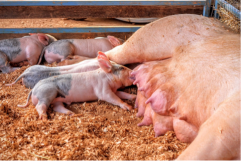 being fattened for slaughter in Ireland. That number includes the pink porkers in the farm up the road. I try not to stand down wind on warm summer days. Was there something special about the Danish rashers? Not particularly. Just the fact that they were organic, more expensive and had a higher percentage of pork than the Irish rashers.
The truth is we can produce run of the mill conventional pork until the pigs trot into the concrete fattening houses but not enough organic pork. It’s a statistical fact that at a third of the European average, we’ve a dismal percentage of organic farmers versus other European nations. It’s also surprising because organic farming is generally more profitable (than other models) which is an important starting point. There’s other positives: it’s generally less intensive, enjoys better margins, attracts better grants and demand for organic products is outpacing supply (except perhaps for lamb where there’s little if any price premium).
Perhaps it’s because we’re slow to change our ways in Ireland and the transition from conventional to organic farming is challenging. And without doubt, organic farming isn’t a cure-all and may not work for many farmers (just as ostrich and deer farming never caught on). Still, none of this explains the low uptake of organic farming in Ireland. So why don’t farmers want to go organic?
WHY WONT FARMERS GO ORGANIC?
One answer is that some are happy. Happy with their return on investment, the effective wage per hour when calculated against income. Farmers who’ve found a niche or vast economy of scale. These farmers exist and they are doing fine farming conventionally using intensive systems and doing everything that the environmental movement hates – using lots of fertilizers, pesticides and antibiotics. It works for them so why would they change?
However for every farmer like the one above, there are many not doing so well. The average farming income is stagnant or falling. Working long, unsociable hours and making a negative return on investment. (Of course lack of profits isn’t affecting the meat factories, the food processors, the suppliers to the farmers or the supermarkets selling on the end product. They all make profit almost every year – if they didn’t they’d go bust.) The truth is the average Irish farmer would be financially better off putting the same amount of working hours into stacking shelves in a supermarket and putting his/her land out to rent or into forestry. Or they could consider a new farming enterprise, one of which might be organic farming.
The thing is, many won’t even consider organic farming as an option. Many seem aware of the pitfalls and drawbacks and none of the advantages. But here’s the crux! Many farmers have never considered that some in the greater farming industry would prefer if the average Irish farmer didn’t rock the boat by going organic. The simple truth is that there are those who will lose out financially if more farmers go organic. And I’m guessing that their opinions are having a negative effect on the general perception of organics within the wider farming community. They include:
- The agro-chemical companies who supply pesticides, herbicides and fungicides which are heavily restricted in organics.
- Petroleum based fertiliser manufacturers lose out as farmers maximise on-farm sources of manure and natural nutrient to improve soil condition.
- The local farming cooperatives / stores who sell all of the above see a drop in sales.
- Vets are generally busier in conventional farms as large numbers of animals are pushed through more intensive systems.
- And the drug companies supplying the medicines to fix sick animals see a falloff in their sales.
To conclude then: for those would be organic farmers, be sure to take all your organic information with a pinch of salt.
The May noticeboard can be found here
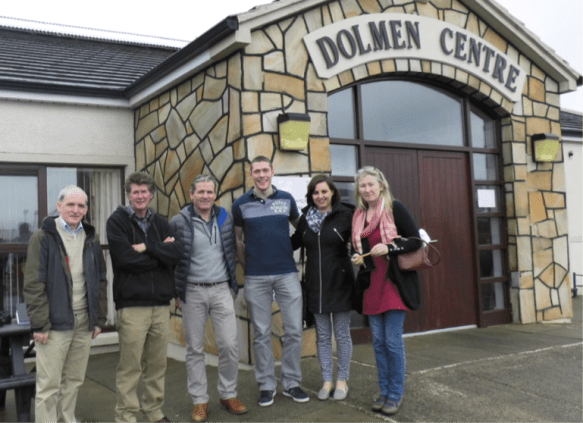 Pictured at the Sustainability Energy Communities border networking event at the Dolmen Centre, Portnoo, Co Donegal were Liam Murtagh, Castleblayney Sustainable Energy Group, Mel Gavin, IT Sligo, Seamus Dunbar, Manorhamilton, Leo Murray, IT Sligo, Kenneth Doherty, Dolmen Centre, Gillian Gannon, SEAI and Eithne Ní Lochlainn, Gortahork.

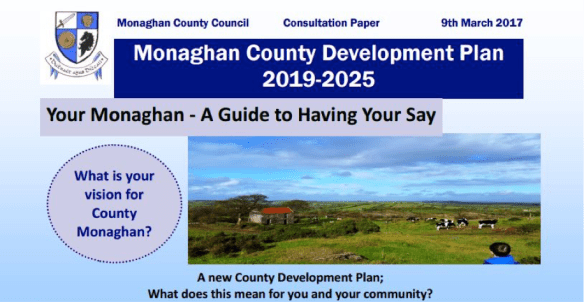 Above is the opening section of Monaghan County Council’s consultation paper in relation to the 2019-2025 Development Plan. The paper poses questions and seeks your opinion on how the current issues facing your community can be addressed. Suggestions for the Plan on how our communities could move to a thriving low carbon economy / society would no doubt contribute positively to the common good. The full paper can be viewed on
  affordable technology to ‘deep retrofit’ your home or by installing a heat pump or Solar PV this could become a reality. The people in SEAI have been highlighting the opportunities.
  The showroom of Energy Panel with roof mounted PV panels. The local company had a stand at the Business & Community Exhibition in Castleblayney on Saturday last. Energy Panel supplies and installs solar PV and other energy related products.
  Liam Murtagh of the Castleblayney Sustainable Energy Group gives Deirdre McGinn some information on energy efficiency grants at the Business & Community Exhibition in Castleblayney on Saturday last.


 vegetarianism because we claim that one person cannot really make a big difference. In my view that is a cop out. Eliminating meat from our diet cuts our carbon footprint automatically in half. This is a significant contribution and by making this change we are also encouraging others to follow suit.
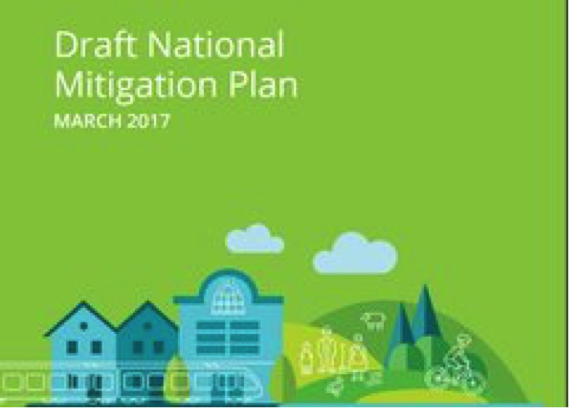 harmful emissions that contribute to climate change. A requirement under our climate legislation, the Plan must establish how Ireland will reduce emissions from buildings, agriculture, transport, and energy production. Liam Murtagh looks at the response of Minister Naughten and climate campaign groups to its publication and also how you too can respond.

 The lack of definite and planned actions in moving Ireland to a low carbon economy was also reflected in the comments of spokespeople for the Stop Climate Chaos Coalition. Cliona Sharkey, Policy Officer with Trócaire and a Coalition spokesperson said: “The Plan locks Irish society into regressive and unjust actions for the next five years. This will not only hurt our economy in the long-term as the impacts of climate change worsen, but will also have significant environmental and human costs, affecting the most, poorest communities here in Ireland and abroad’
 engage and seek consensus across society on enabling the transition to a low carbon and climate resilient future.” There will be a range of national, regional and local initiatives. Among possible one mentioned were Public Participation Networks, Climate Gatherings, People Talk and Citizen Juries, The People’s Conversation, and Climate Justice: Evidence to Action. There are already plans to involve young people through the BT Young Scientist competition and the Green Schools Programme – and under it a ‘Climate Expo’ is planned for this autumn.
 Transition Monaghan