‘The True Cost’ of the Clothes we Wear

When was the last time you bought a cheap t-shirt in a high street store and thought about its origin or how it was made? Jenniftrue coster McAree of Transition Monaghan reviews a ground-breaking documentary film called ‘The True Cost’ that pulls back the curtain on the untold story and asks us to consider, ‘who really pays the price for our clothing?’

Photo courtesy: ‘True Cost’

I watched this documentary recently on Netflix. I have an interest in both fashion and sustainability, so the film’s message of the disconnection between the act of buying my clothes and their source really hit home. Most of us don’t think about the origin of the clothes we buy. We are delighted to bag a bargain €20 pair of jeans, but the person making them might receive under 50c for the privilege.

Ninety-seven per cent of our clothes are now made overseas. There are 40 million garment workers worldwide and of these, 85% are women. The ‘True Cost’ film focused on Bangladesh, India and Cambodia, where labour costs are low and weak worker protection and environmental laws exist.

Conditions in garment factories were highlighted in April 2013 when the ‘Rana Plaza’ complex collapsed in Dhaka, Bangladesh, killing 1,133 people and injuring 2,500. Many were employed to produce clothes for stores like H&M and Primark (Penneys). We have become de-sensitised to the term ‘sweatshop’, but it really comes to life on screen. On a trip to Bangladesh some years ago, creators of the film saw that each employee worked very long days and was under strict instructions to make up to one hundred pieces an hour. They had two toilet breaks per day and if anyone fell ill and missed work they were fired and replaced immediately.

Personal stories were told throughout the film. An intelligent young Bangladeshi woman works hard to survive and raise her little girl. She cannot afford child-care and by taking her daughter to the factory she exposes her to harsh chemicals, so she must leave her with relatives in the countryside for good. Villages in India have been ruined with chemicals running directly into water supplies from the dyeing processes. Numerous local residents have suffered from cancer and other diseases which it is claimed is related to these chemicals. In the countryside, heavy spraying of pesticides on cotton crops has led to many children being born with horrific life-long complications.

In Cambodia, garment workers tried to protest peacefully about their paltry wages and conditions, but some were attacked and even killed by police in the process. Large fashion multinationals say they have no control over foreign workers’ circumstances, but that they are trying. An example of a company that is recognised as a pioneer in Fair Trade and environmentally sustainable fashion is the UK based company ‘People Tree’. Unfortunately few such alternative companies exist, but the fashion world is starting to take note in some quarters.

This documentary was hard to watch but it has catalysed a change in my buying behaviour. I have since avoided high street shops where possible, look at labels and follow websites such as www.ethicalconsumer.org. Clothes made in European countries like Portugal and Romania are more likely to be ethically produced and organic cotton is best. I visit charity shops more often and plan to take a sewing course in order to make and mend by myself! If you do one thing this week, be sure to watch ‘The True Cost’ on Netflix, download it or buy the DVD from http://www.truecostmovie.com.

Clogher Justice, Peace & Integrity of Creation Group Launched Bishop MacDaid urges action on the refugee crisis

clogher

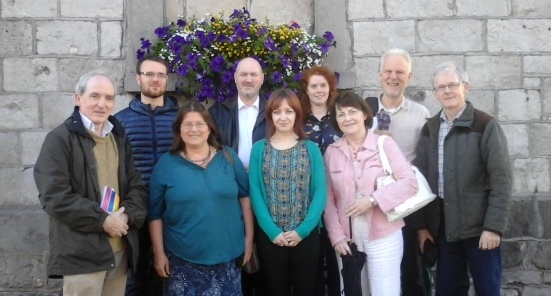
Pictured at the launch of the Clogher Justice, Peace & Integrity of Creation Group in Enniskillen were: front row (left to right) Ann Molloy, Neville Armstrong, Fr Joe McVeigh, Patricia McKeever, Bishop Liam MacDaid (who launched the Group), Andrea McManus and Sr Mary Kate Hagan. Back row: Sr Nellie McLaughlin, Paddy Gilgunn, Liam Murtagh and Dermot McCarron.

The Clogher Justice, Peace and Integrity of Creation Group is a new diocesan based group that aims to highlight issues of social injustice at home and abroad and undertake or support local responses. In launching the Group, Bishop Liam McDaid said that he believed that the Group will “help all of us in this beautiful part of our world to be more aware of our responsibilities with regard to justice and human rights and the protection of Creation”.

The formation of Justice, Peace and Integrity of Creation Groups in each diocese is being encouraged by Catholic bishops nationally. Members of Clogher Group come from Counties Monaghan, Fermanagh and Donegal. The Chairperson is Patricia McKeever and the Secretary of the Group is Neville Armstrong. The Group was convened by Fr Joe McVeigh and support in its development was provided by Roisin O’Hara of Trocaire. The launch on Thursday, 3 September took

place at the premises of Waterways Ireland in Enniskillen and was very well attended. Among the various speakers was Dean Kenny Hall of the Church of Ireland, who in his address wished the initiative well, saying that its objectives are ones that are shared by all Christian churches.

The Group will focus initially on the issue of climate justice and also on the homelessness issue. In his address Bishop McDaid referred to the current refugee crisis. “We have all been shocked and moved to seek appropriate action when we are brought face to face with the plight of refugees in different parts of our world…. We realise that we all need to be disposed to search ourselves and to urge our governments to search for the causes of this distress and to take whatever steps are necessary to create a situation in our world where the gifts of creation are shared in such a way that justice can be seen in action and we never witness the horror of a mother and child found washed up dead on a shoreline trying to escape from a situation which should not exist”.

The Clogher Justice, Peace and Integrity of Creation Group plans to develop initiatives that will involve parish groups and, in particular, younger people throughout the diocese. For further information on the Group, email clogherjpic@gmail.com

Transition Monaghan AGM: New Members Sought for Innovative Projects

Pictured above are some of those who attended the recent Transition Monaghan AGM.   Front row (left to right): Liam Murtagh, Margaret Palmer, Jennifer McAree, Susanah McKeon, John McKeon.  Back row:  Mícheál Callaghan, Michael Connolly, Dearbhla Lenehan and Ollan Herr.

Pictured above are some of those who attended the recent Transition Monaghan AGM. Front row (left to right): Liam Murtagh, Margaret Palmer, Jennifer McAree, Susanah McKeon, John McKeon. Back row: Mícheál Callaghan, Michael Connolly, Dearbhla Lenehan and Ollan Herr.

On Saturday last Transition Monaghan elected their new committee for 2015 – 2016 at their AGM in Monaghan town. The group also reflected on a busy year and discussed a number of innovative sustainability projects planned for the coming year. Mícheál Callaghan who was re-elected Chairperson says that anyone who is interested in joining the Group to become involved in a project would be welcomed by the group.

The new committee is comprised of Mícheál Callaghan (Chairperson), Conan Connolly (Secretary) and Michael Connolly (Treasurer). Transition Monaghan is a county wide voluntary initiative which seeks to promote sustainability and well–being in Co. Monaghan. As well as this weekly column, we run a number of events throughout the year, such as our cost efficient home event last year. We have just received a grant from Monaghan County Council to take part in their 2016 commemorations next year. We will begin work shortly on organising an event which looks at how various groups can improve the quality of life in Monghan over the next 100 years, with various sustainability challenges in mind, such as climate change. We will also focus heavily on updating our website and reaching out to new members over the coming years. Membership is free, and we always welcome new input and ideas. If you feel that you have an idea to suggest, or some time to give to the group over the coming year we would love to hear from you. In particular, we would welcome any volunteers with expertise in PR and web – design, as well as anyone with a background in the arts or culture who may have ideas for creative campaigns and event. You can get in touch with us on transitionmonaghan@gmail.com

Mobilising for Paris Climate Conference

The Climate Conference (COP21) in Paris this December represents an important moment in the struggle to tackle climate change. For two weeks (30 November – 11 December) leaders and teams of negotiators will be locked away in negotiations to hammer out a new global deal on climate change. Here in Ireland the ‘Stop Climate Chaos’ coalition is planning to facilitate a group of people to travel to Paris to participate in activities on 11 & 12 December. As part of the mobilising of young people An Taisce proposes to create a ‘National Youth Forum for Engagement with Climate Change’. They are seeking crowdfunding support, i.e. donations in order to help support the initiative. For details on the above see ‘Latest News’ at www.antaisce.org

Thought for the Week

Earth Overshoot Day fell on 13 August and it’s getting earlier each year. Humanity has already used up 100 per cent of the resources ‘budget’ produced by the Earth this year, which means that any consumption from now on represents an unsustainable burden on the planet , i.e. mainly in the form of biodiversity loss and the effects of climate change. ‘Earth Overshoot Day’, the moment when humanity exceeds nature’s budget for the year was reached six days earlier than in 2014. The Global Footprint Network (GFN) sustainability think-tank tells us that humanity lived within the Earth’s means up until 1970 but, driven largely by carbon emissions, it has been steadily increasing the debt ever since. See http://www.earthovershootday.org.

Transition Monaghan Group’s Invitation to AGM

Transition Monaghan will hold their Annual General Meeting on Saturday, 29 August in the meeting room of Andy’s Bar & Restaurant, Monaghan, at 3pm. Chairperson of the group, Mícheál Callaghan says that everyone is welcome to the AGM and that the event is intended to provide an opportunity to learn more about the work of Transition Monaghan and to see if they wish to be involved. He outlines below the type of activities the group undertakes.

Transition Monaghan was founded in March 2013, and is part of the worldwide Transition Town movement, founded in Kinsale, which aims to promote local sustainability and boost well – being in communities. As well as our regular column Northern Standard column, we hold regular events which promote aspects of sustainable living, and we also collaborate with other community groups on local projects. In spring of this year, we organised a free public event, ‘Your cost efficient home’, which featured presentations on how to reduce energy usage and reduce bills in the household. Last year we ran an ‘Introduction to Permaculture’ course, which looked at ways of designing sustainable systems for gardening, home energy usage and other aspects of life. We hope to run a sustainability skills seminar or festival in the near future. Currently we are collaborating with Monaghan Tidy Towns on a biodiversity project in and around Monaghan town.

We are always open to new ideas – including fun ones! – and welcome new volunteer input. ‘With the all-important climate change conference this year in Paris and our natural world being put under ever greater pressure there has never been a better or more important time to be involved in promoting sustainability. Further information about Transition Monaghan can be found on our Facebook page or our website http://www.transitionmonaghan.org. Queries may be emailed to transitionmonaghan@gmail.com.

Spud Tasting Competition This Weekend in Carrickmacross

Untitled1

This Saturday, Carrickmacross will see its very own spud tasting competition (An Spud Off Mór) take place in John Joe Cunningham’s at 1pm. Potatoes can be boiled or steamed, without any added ingredients, and will be blind test tasted by a panel of tasters. The idea is to promote ‘growing your own’ and to have a fun competition that encourages everyone to ‘savour the flavour’ of local potatoes. Anyone from South Monaghan wishing to enter their spuds should contact Conan on 086 064 1864. Further details on entry and criteria are available at http://www.transitionmonaghan.org.

                                                                 Conan Connolly is inviting people to enter                                                                           or just come along to this Saturday’s                                                                spud tasting competition in Carrickmacross.


An Spud Off Mór 2015 – a Tasty Potato Competition

conan

Conan Connolly of Transition Monaghan is on a mission to find the tastiest potatoes in South Monaghan and encourage more people to grow their own. He is looking for potato growers to join in a new type of potato growing and tasting competition. Here he fills us on the details of ‘An Spud Off Mór’

What is it? It’s a competition to find the best potato in South Monaghan. The idea of the growing and tasting competition started in Co Kerry and we thought it would be great to try it out in Co Monaghan.

Why have it? Firstly its to celebrate the humble spud, its importance to our diet and in our history.

Continue reading

Philip McCabe becomes World Beekeeping President

Monaghan born Philip McCabe, who is a well-known beekeeper, is set to take up duty as the President of Apimondia, the world beekeeping federation. Philip has been President of the European Commission for Beekeeping for the past four years. He is also well known in Monaghan in his role as Development Manager of Co Monaghan Citizens Information Service where he has served for the past 15 years.

phillip

Speaking on RTE Radio on Sunday last, Philip said that his work as President of the world beekeeping body will focus on redressing the issue of the massive decline in bee numbers worldwide. As honey bees and other types of bees are necessary for the pollination of many food crops it is important for the world food supply that bees are protected.   Philip highlighted the overuse of chemicals and GMOs in agriculture as one of the main causes of the loss of bees. This is going to be a big challenge for Philip and for Apimondia, as many countries are not taking sufficient action to address the problem of the loss of bees. As evidence of this, it has just been reported that the Government in the UK has just lifted its ban on the use of neonicotinoid pesticides in agriculture – these chemicals have been found to be a cause of the collapse in bee numbers.

Philip McCabe has also highlighted the importance of bees in the alleviation of poverty in developing countries. ‘Bees for Development’ is an initiative involving people in developing countries being helped to develop beekeeping enterprises. In regard to beekeeping in Ireland, Philip says that there is an increasing interest in keeping bees and this means that bee farmers and experienced beekeepers are busy supplying new colonies of bees to new beekeepers. He also mentioned the potential in Ireland for harvesting pollen from bees, in addition to honey, as there is a good market for pollen products.

This week sees the annual beekeeping summer school taking place in Gormanston, Co Meath. Philip will be busy there, both arranging and delivering lectures and workshops at this well attended event.  Philip, who grew up in Newbliss  is a third generation beekeeper – his father and grandfather  were also beekeepers.  He now lives in Termonfeckin where he looks after his own and the bees at the An Grianán centre –  the ICA headquarters. As Philip moves to his new role as Apimondia President in September,  when he attends its Congress in Daejeon, South Korea,  we all wish him every success in what is a prestigious role but also a challenging one.

For further information on beekeeping including local beekeeping groups and becoming a beekeeper see www.irishbeekeeping.ie. On alternative / natural approaches to beekeeping see http://www.bees.ie.   For information on ‘Bees for Development’ see www.beesfordevelopment.org.

The Environmental Pillar demands Coillte stop using Hazardous Pesticides in Irish Forests.

The Environmental Pillar which represents 28 national independent environmental non-governmental organisations is demanding that Coillte stop using the pesticide Cypermethrin in Irish forests. The pesticide Cypermethrin is designed to protect non-native spruce and pine trees from weevil attacks. Coillte has used it to pre-treat plants in the controlled environment of nurseries since early 2007 and to dip young plants. The chemical is also sprayed on the land in an effort to control the impact of the pine weevil. Coillte has used Cypermethrin operationally since 2007 and over that period has applied over 100,000 litres of the chemical.  The company Coillte plans to continue to use this chemical for the next five years.

Cypermethrin is a fast acting neurotoxin in insects.  As it is a pesticide, it kills beneficial insects and animals (like birds, bees and fish) as well as the targeted ones.  The Environment Pillar says that this has a major adverse impact on our biodiversity as using this pesticide in our forests furthers the pressures on pollinators like bees to survive.  The group says that the survival of these pollinators is vital for the continuation of our food production. The US EPA has also classified Cypermethrin as a group C carcinogen, so not only are we harming the environment by using this chemical, we could also be directly harming ourselves.  The Environmental Pillar representatives say that Coillte should change over to a natural forest model in which mainly native tree species are grown. The successful growing of native trees is not dependent on the application of hazardous chemicals like Cypermethrin.

Climate Scientist Criticises Meteorologist for “Misrepresenting” IPCC Climate Reports

A recent article by Irish meteorologist Professor Ray Bates claimed that “increased uncertainty” in recent IPCC (Intergovernmental Panel on Climate Change) reports on the likely course of future climate change means that Ireland need not take steps to urgently reduce its greenhouse gas emissions. Rather, Prof. Bates argued that we should prioritise protection of our own, Irish, economic interests. The supposed scientific basis for Prof. Bates’s argument has now been criticised by Ireland’s leading climatologist, Professor John Sweeney (Professor Emeritus at Maynooth University, former Director of the Irish Climate Analysis and Research Unit, and a full IPCC contributing author).

In his critique, Prof. Sweeney states that the article by Prof. Bates contained numerous “scientific inaccuracies” and he goes on to detail how the article appears to engage in clear “cherry picking” and systematic misrepresention of the IPCC’s Fifth Assessment Report “to suit Prof. Bates’s own arguments”. Prof. Sweeney affirms the unambiguous scientific consensus that far from slowing or stopping, the overall warming of the Earth is continuing, and indeed accelerating, and this is unequivocally associated with human activities. He goes on to say that it’s absolutely valid to describe the problem of climate change as a “planetary emergency”. He concludes by highlighting the need to view climate action in a context of global climate justice, and he firmly rejects narrow ‘national interest’ as a message Ireland should wish to send the world on this issue. Prof  Sweeney’s remarks were endorsed by Barry McMullin, Chair of the An Taisce Climate Committee.

Meanwhile President Michael D Higgins this week addressed the European Economic, Social and Environmental Council’s climate change seminar in Paris. The conference focused on the involvement of citizens, with President Higgins saying the role of each citizen will be “decisive in reaching the ambitious agreement mankind needs”.