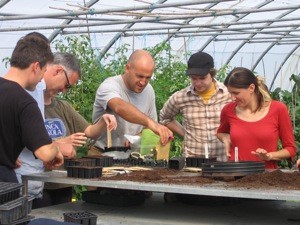
Two members of Transition Monaghan recently met with Irish MEPs while attending events in Brussels related to climate change, sustainability and Free Trade.
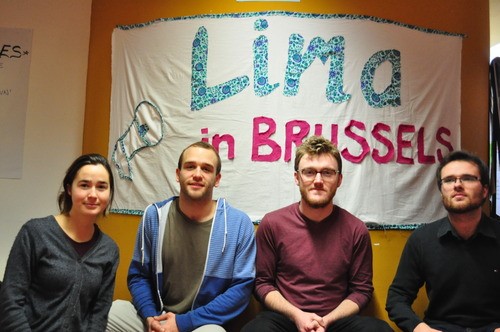

Two members of Transition Monaghan recently met with Irish MEPs while attending events in Brussels related to climate change, sustainability and Free Trade.
After the recent extreme weather events experienced here and in Britain there is now a lot of focus on the need for all of us to live more sustainably so that we don’t have runaway climate change and other ecological and social catastrophes. Sustainable living involves finding the right balance between utilising resources and protecting the planet. Some of the key elements of sustainable living involves reducing our carbon footprint and this has implications for many aspects of our lives including what we eat, the energy we use to heat our homes, our means of travel etc. There are many training course and initiatives in which we can participate that will give us skills to live more sustainably. This week we look at some of these in Ireland.
Continue readingThis Saturday (October 18), members & friends of Transition Monaghan will gather at Ballybay Wetlands Centre to discuss a road map for sustainability in Co. Monaghan. The focus of the sustainable future workshop, will be to focus on a number of key areas that Transition Monaghan, in collaboration with other groups and individuals, can direct their energies on to promote and achieve greater sustainability, in Co. Monaghan, over the coming years.

Ballybay Wetlands will host this Saturday’s event, Planning for an uncertain future in Co. Monaghan.
The brainstorming workshop, which will begin at 2pm, will focus on the aspects of our lives that are deemed necessary for prosperity and how we can reconcile those with the need for sustainability in the face of the great challenges of the 21st century, namely climate change & peak fossil fuels. Small group discussions will focus on how we can reconcile our human needs with those of nature to allow for a sustainable and prosperous future in Co. Monaghan. The goal will be to create an action plan, spanning the next number of years, for events and projects to be carried out by Transition Monaghan, in collaboration with others. The theme will be in line with the maxim of “Think Global, Act Local”, as any actions that we take will focus on how we, as a community can improve our situation in the context of global challenges. Discussions will bear in mind areas deemed necessary for human and planetary prosperity, including: water, food, energy, biodiversity & health.
The workshop, which begins at 2pm, will provide the opportunity for those with an interest or curiosity in environmental issues to meet and share ideas and opinions with one another. All ideas and contributions are highly valued, and these will form the basis for the creation of a realistic action plan for Transition Monaghan into the future. Tea and coffee will be provided and the event will end at 4pm. It should be an interesting and engaging afternoon, set in the beautiful surrounds of Ballybay Wetlands. If you would like further information please contact Mícheál at transitionmonaghan@gmail.com
The state of the climate – and what we might do about it
The well-known economist Nicholas Stern recently delivered a ‘TED’ talk entitled, ‘The State of the Climate and what we might do about it’. He opens the talk with these words; “We are at a remarkable moment in time. We face over the next two decades two fundamental transformations [in the structure of economies /societies worldwide and in the planet’s climate] that will determine whether the next 100 years is the best of centuries or the worst of centuries.” His closing words are; “Are we going to look our grandchildren in the eye and tell them that we understood the issues, that we recognised the dangers and the opportunities, and still we failed to act? Surely not. Let’s make the next 100 years the best of centuries.” The full 16 minute talk can be viewed online at www.ted.com.
Ban Ki-Moon, Secretary – General of the UN says: “Future generations will judge our actions on climate change”. Last week at the UN Summit in New York on climate change, 120 government leaders each made 4 minute speeches. While no decisions were made at the summit, it has however highlighted the urgent need for agreement by these leaders to commit to major reductions in greenhouse gas emissions when the climate talks take place in Paris next year.
An article in the New York Times that was also published in the Observer newspaper on Sunday last says that in just 30 years millions of Americans will become climate refugees in their own country. Jennifer A Kingston’s report sets out how American land and cities will be affected by rising temperatures, sparking huge population shifts to newly desirable locations further north like Detroit, the Pacific Northwest and Alaska. See online copy of the article at www.theguardian.com/environment. Similar population shifts to those expected in the US are also likely to happen in Europe and in other parts of the world.
An EPA lecture to update us on climate change will take place in Dublin on this Monday, 6 October. On the same evening a talk focusing on people’s attitudes to climate change will be held in Trinity College. Here in Monaghan an event to highlight and discuss the issue of climate change will take place in the Hillgrove Hotel on Saturday, 11 October. See Noticeboard above for details of these events and how to book a place.
Taking an Eco Tour of Ireland
Roz Kelly founder and owner of EcoActiveIreland.com recently decided to embark on an ‘eco tour of Ireland’. Roz says: “Ecotourism and nature related activities account for 20% of global tourism, a figure that is set to grow in the coming years”. She’s been visiting a range of ecotourism attractions and facilities nationwide and meeting the people involved such as at Rock Farm in Slane and The Three Towers Eco House & Organic Kitchen near Slieve Aughty, Co Galway. Her tour is now near an end and to date she has been cycling, birdwatching, kayaking, surfing, glamping (glamorous camping), staying in an organic farm guesthouse and an ecocabin, experiencing a seaweed bath and visiting a cheesemaker, a natural perfumery and many other interesting places.
Roz is using a sponsored Opel Mokka ecocar for her travels. A bonus has been the fact that the countryside has been looking its best in the recent spell of early autumn sunshine.
The eco tour is being featured on RTE Radio One’s CountryWide programme on Saturday mornings. Roz is also blogging and tweeting about her tour. For more on her eco tour see www.ecoactive.com and Twitter at ‘ecoactiveirl’ and ‘ecoactive Ireland’ on Facebook. For other information on ecotourism see www.discoverireland.ie/Where-To-Stay/Features/Stay-Green and also www.ecotourism.ie.
The number of activists and citizens across the world challenging the fossil fuel industry and demanding radical action on climate change is increasing. In advance of the upcoming Climate Summit in New York, people are being urged – wherever in the world they are – to join in the People’s Climate Mobilisation for their Global Day of Action. Simultaneous marches and gatherings will take place in cities across the world, in order to send a clear and unavoidable signal to the world’s elite that action is urgently needed!

The growing mobilisation of people across the globe against the climate crisis is being likened to the movements against racism in the USA or apartheid in South Africa, and in reality, a similar level of public outrage is required.
In Dublin, members of the public are invited to attend the Climate Picnic this Sunday afternoon 21 September from 12 – 2pm at the Band Stand, St. Stephen’s Green. Members of Transition Monaghan will be in attendance. Everyone is welcome to go along to what is expected to be an enjoyable event that includes music and circus performers. It should be an event that is positive and hopeful and that will make a difference for future generations. The organisers advise those attending to bring a picnic, banners and friends!
The fossil fuel lobby is one of the most powerful and politically influential in the world. Only when it is seen as unacceptable to do business with them, will our politicians begin to take a step back from their influence. Public outcry over involvement of the tobacco industry in politics and health policy lead to a completely new direction being taken on smoking. The same is possible regarding fossil fuels and climate change, but it will need ‘buy in’ from the public. Bill Mc Kibbon, author and founder of 350.org descried the fossil fuel industry as “a rogue industry. It’s an industry if whose business plan is followed to the letter, it will wreck the planet”.
Why does this affect us in Co. Monaghan?
Climate change will cause increased conflict worldwide over dwindling resources such as drinking water and land. In this century climate change refugees will be leaving in their millions from the countries most affected by the extreme weather events. This will also lead to increased conflict that will have considerable impacts worldwide.
Co Monaghan, like every other place on the planet, is being and will continue to be affected by climate change. In the last number of years, we have seen many extreme and record breaking weather events. Last winter’s storms, which wreaked havoc for everyone, were part of the stormiest winters on record. Recent dry weather, has seen the transporation of vast quantities of water into communities around Ireland. As climate change continues to accelerate, these ‘extreme’ weather patterns will become the norm. In the short to medium term, the winters are expected to become wetter and windier and summers expected to become drier and warmer. If greenhouse gas emissions continue, the long term outlook is runaway climate change. This will affect the balance of nature and the biodiversity and ecology on which we depend.
Agriculture is an important part of the economic and social fabric of Monaghan. It is predicted that, if left unchecked, climate change will cost Irish agriculture up to €2 billion per annum. It is still entirely possible to avoid the worst case scenario and to put in place mitigation strategies for the disruption that we will face.
As individuals and communities we can take action to reduce our own carbon footprint and build our own resilience. However, we must also put pressure on our political and business leaders to take the action that we and our children deserve. This is the challenge of our time. Make sure your voice is heard!
Web links:
www.peoplesclimateireland.wordpress.com;
Water is the most precious natural resource on the planet. With the imminent introduction of water charges, the whole country is thinking about water usage. Regardless of one’s opinion on water charges, as a nation we must address our often wasteful use of water, particularly as we can expect uneven distribution of rain in the future. We discuss some of the main issues around water usage and a number of ways in which we can use it more sustainably, and keep our bills down.

Humans are made up of about 65% of the stuff, we need it to keep us alive and wash ourselves with. Clean water is so important to human survival and quality of life. We are lucky in Ireland that we have access to clean water and that we have the infrastructure to treat and distribute it. However it does cost a lot to treat water so that it is of drinkable quality and if our rivers and lakes are polluted the cost of treatment can be very high. It is often assumed that we don’t need to worry about how much water we use as it rains so much here. This is not quite the case. In recent weeks, off shore islands, including The Aran islands and Cape Clear, have had to import up to 50,000 litres of water per day, as a result of the dry weather.
It is predicted that climate change will lead to drier summers, resulting in certain parts of the country becoming affected by drought, while the population of the driest parts of Ireland, along the east coast, will increase.
What can I do?
Using Less Water
Saving water often comes down to awareness and monitoring usage. An average Irish person uses 150 litres of water every day, much of which is flushed away, although this figure can vary greatly. For example, a seven minute power shower uses about 175 litres of water compared to 49 in a conventional shower – a massive difference! By simply doing things like taking shorter showers we can make a difference.
Using water more efficiently
Another very simple step comes down to using water in a more efficient manner. Not leaving taps running, having leaks fixed and only using water when necessary all help. If you turn your tap off when brushing your teeth you can save 6 litres of water per minute, and up to 7,000 litres per year. Furthermore, devices such as washing machines, which use large amounts of water should only be used when full.
Grey Water
Bathrooms see the most water use, with toilet flushing accounting for about 40% of a household’s average water usage. In many countries around the world, you will find cisterns with dual flush options, which limit the amount of water used. An alternative to this would be to use a toilet displacement device, which can either be purchased very cheaply, or home made. It is a device, such as a plastic bottle or tube, filled with water, which you place in the cistern. This displaces some of the water needed to flush the toilet, and it can save you up to 3 litres of water per flush. A device can be made from an empty juice bottle or carton, of about 1.5 – 2 litres. You fill it to add weight to it, which will then displace the water. At least a part of it should be filled with sand or gravel, so that it does not bounce around the cistern. Another option, is the recycling of grey water from showers and washing machines. While this water may appear dirty, it is perfectly fine to use in the garden. Grey water recycling kits or pipe add ons can be purchased at a low cost.
Rainwater Collection
It is a shame that we don’t make maximum use of our abundant rainfall. Rainwater collection tanks or rainwater harvesters are excellent and can be hooked up to domestic water tanks. Usually rainwater is used for non-drininking uses but there are add-on devices available to make rainwater drinkable. . At a simple level, tanks and barrels can be used to collect rainwater for garden use, saving your mains supply.
Water butts are tanks, of around 200 litres, that are connected to the end of downpipes, diverting rainwater from drains, allowing it to be collected and used in the garden. More complex tanks can be purchased with filtration systems and pumping mechanisms. In many countries rain water collection is very common and is heavily encouraged due to extremely dry conditions. Earlier this year, former Minister for the Environment, Phil Hogan, announced plans to introduce legislation requiring all new builds to have rainwater harvesters installed, stating that this could reduce household consumption by 50%.
Conclusion
Water will only become an even bigger issue in the future. We can save ourselves money and do our bit to conserve our most precious natural resource by following some of the steps above.
The number of activists and citizens across the world calling bluff on the fossil fuel industry and demanding radical action on climate change. The temperature is rising ahead of the New York Climate Summit. In advance of this summit, people are urged to join in the People’s Climate Mobilisation for a Global Day of Action, wherever in the world they are. The idea is to have simultaneous marches and gatherings across the globe, to send a clear and unavoidable signal to the world’s elite that we demand action!
In Dublin, members of the public are invited to attend the Climate Picnic on Sunday 21 Septembe from 12 – 2pm at the Band Stand, St. Stephen’s Green. Bring some sandwiches, bring banners, bring your friends!
The short film Disruption charts the urgency of the climate movement, and how we can come together to pressurise the world’s leaders to do the right thing for their children’s future.
As Bill Mc Kibbon, author and founder of 350.org stated that the fossil fuel industry is “a rogue industry. It’s an industry if whose business plan is followed to the letter, it will wreck the planet. Once you know that, then you know that these are now illegitimate business plans.”
Members of Transition Monaghan will be in attendance on the day. If you would like to join us or meet us there on the day please e-mail transitionmonaghan@gmail.com
This is the cause of our time. Make sure your voice is counted!
Tuesday, 19 August last was ‘Earth Overshoot Day’ – the date our ‘Ecological Footprint’ exceeded our planet’s annual budget. Ecological footprint is a measure of human demand on the Earth’s ecosystems.This year it has taken less than eight months for humans to use up nature’s entire budget for the year and go into ecological overshoot, according to data from Global Footprint Network, an international sustainability think tank. They calculate that it would currently take 1.5 Earths to produce the natural resources now needed to support human requirements.

In 2000 Earth Overshoot Day was not reached until October while back in 1961 it was not reached at all. At that stage we used about three-quarters of the earth’s capacity to produce food, timber, fish and to absorb greenhouse gases and most countries had more resources than they consumed. Most of the world’s population live in countries where the demands made on nature – the nation’s ecological footprint – outstrip what that country’s resources can cope with. Per head of population, we in Ireland are among the countries with the highest ecological footprint in the world and are helping to propel the world into deep ecological debt. The Global Footprint Network says that the costs of our ecological overspending are becoming more evident by the day. They say that the interest we are paying on that mounting ecological debt in the form of deforestation, fresh-water scarcity, soil erosion, biodiversity loss and the build-up of CO2 in our atmosphere also comes with mounting human and economic costs. They see countries with resource deficits and low incomes as being exceptionally vulnerable.
The message poses challenges for Governments, corporations, communities and us as individuals. Many products and services are used with little or no account taken of the ecological impact of that decision. This can range from decisions by Governments and corporations such as the decision to extract oil from tar sands or by fracking to the decisions we make when buying an item in a shop such as one made from non-certified hardwood from a tropical rainforest.
For more information on the Global Footprint Network and its work in tracking humanity’s demand on the planet (Ecological Footprint) against nature’s biocapacity see www.footprintnetwork.org. If you wish to calculate your own carbon footprint see www.foe.ie/justoneearth/carboncalculator.
In Brief
Having a ‘greener’ back to school
The first day of school of the new school year is upon us and as parents and guardians prepare to send the little (and not so little) ones back to their classrooms, the organisation Voice suggests ways to reduce the impact of ‘back to school’ on the environment and even save money along the way. They say ‘greening’ your school preparations does not only mean buying from sustainable sources and products from recycled material, it also means reusing items that still have good life in them. Suggestions include sourcing used uniforms and school books, covering school books, having nutritious lunches minus throwaway packaging and walking/cycling to school. See www.voiceireland.org for more details.
Save money on your energy bill this winter and into the future
The ‘Better Energy Homes Scheme’ provides grants to homeowners to upgrade their homes with energy efficiency measures which can include such works as roof insulation, wall insulation, boiler and heating control upgrades and installation of solar panels. These will not just reduce your energy use and costs, they also reduce greenhouse gas emissions. For details, see http://www.seai.ie/grants.
Certain social welfare recipients may avail of free home insulation. CAMCAS (Cavan & Monaghan Community Area Services), work with Sustainable Energy Authority of Ireland (SEAI) to carry out the’ Warmer Home Scheme’, providing Attic and Cavity Wall Insulation. For further information and to see if you are eligible, contact the CAMCAS office on 049 9527384
Monaghan project in national display of young people’s eco action projects
A showcase of young people’s environmental action projects from around Ireland including a winning project from the Teach na nDaoine Family Resource Centre, Monaghan is running until Friday, 12 September in the European Union House on Dawson Street in Dublin. The Teach na nDaoine project was entitled ‘Class Trash’ and was a winner in the Junior Waste/ECO Art & Design category. The exhibition displays over 20 projects from young people island-wide who participated in ECO-UNESCO’s Young Environmentalist Awards 2014 programme. There were 75 finalists at the Young Environmental Awards Showcase and Ceremony in May 2014 and the exhibition displays a number of the winning projects along with some highly commended groups.
Our former President and founder of the Mary Robinson Foundation for Climate Justice, Mary Robinson has now been appointed to the role of UN Special Envoy for Climate Change. It’s a very important role in the run up to next year’s Climate Talks in Paris. She intends to focus on the severity and human rights implications of Climate Change. Mary Robinson has a big challenge ahead, as has all of humanity, but can she make a difference in her new role.

Former Uachtarán na hÉireann, Mary Robinson, has been appointed UN Special Envoy for Climate Change.
Over the last number of years, Mary Robinson has been extremely vocal on the need for all of society to take urgent action on Climate Change. She is the president of the Mary Robinson Foundation for Climate Justice, based in Dublin, which focuses on highlighting the injustice of climate change and the disproportionate effect it is having on the world’s poorest.
In stark and committed language, she laid out her agenda on a number of morning radio programmes on Monday of last week, saying that climate change is a “huge existential threat to all of us.” She promised to focus her work and energy on reminding leaders that we can’t continue with “business as usual, nor is business as usual with a little bit of green on the side acceptable”. She acknowledged the role that business has to play in combatting climate change and that everyone, as consumers, has a level of responsibility. She is aware of the huge challenges that exist in combatting climate change, in particular keeping warming below the critical threshold of 2 degrees Celsius. If we were to do this, we need to aim towards having a zero carbon economy before 2050. She said that while we only have two decades to act and that it is possible to do it. Countries that act soonest will be rewarded. According to Mary Robinson we need a robust and fair pathway, and that a zero carbon future must be equitable, i.e. ‘less developed’ countries have to be treated fairly. She claimed that the first countries that make moves towards renewable energy will be the ones where jobs will exist in the future and she claims that Ireland can give great global leadership in this area.
Global leaders have promised to construct an international agreement by 2015, that will provide a pathway for action on climate change. While time is running out to achieve meaningful action, there is a growing urgency and recognition that Climate Change is serious and requires a matched response. The signs are everywhere. Global CO2 levels have remained at an historic high of 400 parts per million for the last year, wind storms are on the increase, and this June saw global temperatures 0.7c above the average. We may not see the worst effects of climate change in Monaghan, or in Ireland in the short term but there is no doubt that we will be affected by the impact of climate change in other parts of the world. In many countries climate change is happening more quickly than in Ireland and they have fewer resources to help cope with the effects of extreme weather events and so food shortages and new refugees are the result. It is literally a matter of life or death for many people in these countries who are essentially being affected by the burning of fossil fuels over many years by more developed countries in Europe, America and elsewhere. Rising sea levels is another consequence of climate change and we could see many of the Pacific Islands ceasing to exist this century, while hundreds of thousands of people in low lying areas such as Bangladesh will be displaced. It is estimated that up to 700 million people will be displaced by 2050 as a result of climate change.
Climate Change is real, it is accelerating and it will only get worse without radical action. Mary Robinson certainly has her work cut out, to bring about change in an antiquated system that is often slow to act and bows to pressure from vested interests. However, with her passion, commitment and vision we can be hopeful that she will have a positive impact in her new role and will be a strong voice for a stable future for the planet. We here in her home country need to campaign and give strong leadership in addressing climate change. We can give her our full support by ensuring that Ireland becomes a place that significantly reduces its CO2 emissions. We as consumers have to play our part by cutting our use of oil, gas and coal and also of course reducing our purchases of goods and services that during their production and transport have generated high CO2 emissions. We wish our former President, Mary Robinson, well in her new role.
Over 1,200 submissions have been received by the Government in response to its call for submissions on its Green Paper on Energy in Ireland. One of these submissions was compiled by Transition Ireland. The submission calls for a National Energy Transition Plan bringing together all sectors to create one shared vision for Ireland’s energy.
The large number of submissions received on the Energy Policy Green Paper reflects the fact that many groups and individuals realise that we are at what Minister for Energy, Alex White TD described as an “energy crossroads”. It is generally accepted that we have to significantly reduce our reliance on imported coal, oil and gas, while becoming much more energy efficient and further increasing our output of renewable energy. Furthermore every country needs to move to a zero carbon or carbon neutral as soon as possible in order to meet our commitments to addressing climate change. Carbon neutrality, or having a net zero carbon footprint, is about achieving net zero carbon emissions by balancing the amount of carbon released with an equivalent amount of carbon that is sequestered or captured.
As well at the issues of wind turbines and pylons the controversial issue of possible fracking (hydraulic fracturing) in the border counties has emerged. Fracking is the process of drilling and injecting fluid into the ground at a high pressure in order to fracture shale rocks to release natural gas inside. The issue of energy security has also come to the fore with the recent political and military developments in Ukraine and Russia which have highlighted Europe’s over-dependence on natural gas that is being imported by pipeline from Russia.
The Transition movement has evolved to build community resilience to better prepare our communities for the inevitable environmental, societal, political and economic shocks that climate change and resource depletion are causing and will continue to cause. The aim of any transition initiative is to foster and strengthen its communityʼs resilience in light of these challenges. In this context the Transition movement has, in various countries, been involved in policy work and practical projects. A recent example has been the publication of an Energy Descent Action Plan for Co Kerry by the Transition Kerry initiative. In it the target is set out to have 100% renewable energy in Co Kerry by 2030.
The Transition submission on the Green Paper outlines some key elements to its proposal for a National Energy Transition Plan for Ireland. These include raising awareness, creating a shared vision, designing pathways for that vision and some definite proposals. The submission was co-ordinated by Theresa Carter. Theresa is passionate about sustainability and has undertaken a range of transition initiatives at national level and locally in Co Laois. The following are some of the key points in the submission.
Raising awareness and creating a shared vision
It is paramount that everybody has an understanding of the basic factors underpinning our national energy plans: climate change and energy security for all. There must be informed debates, discussions and conversation about all considerations for this national policy. The Aarhus Convention states that we all have a right to information relevant to our environment. The Irish Government needs to play an active role in providing impartial, factual information on all aspects of energy plans, policies and projects to its citizens at the preplanning stage.
Transition Ireland is calling for facilitated conversations in every town so that all considerations for national energy policy can be explored. Climate change and our over dependence on imported energy must be presented and discussed so that the challenges are understood and the solutions can be nurtured. Transition calls on the Government to set up a national public participation working group on energy policy, that can ensure public participation is given the consideration it deserves and ensure compliance with the Aarhus convention.
Targets and proposals
Once a vision has been created, a timeline of targets must be agreed. These need to be in line with our targets as part of the EU. However locally the targets will probably be higher as communities engage with the shared vision for a more sustainable economy and
Energy security is a massive threat to western society but the greatest known threat to humanity and life on earth in general, is climate change. Transition Ireland and Northern Ireland want to see:
Community Energy Policy Position Paper
Next steps
According to the Department of Energy, the written public consultation will be followed by detailed analysis by officials in advance of further public engagement at various events commencing this October. Drafting of the White Paper will then begin with a view to publication in mid-2015. The Department says that the new Energy Policy Framework will be “timely, in that it will be guided by Ireland’s input to the EU’s 2030 Framework for Climate and Energy policies and the preparations for the UN’s COP21 in Paris (the 21st Conference of the Parties within the United Nations Framework Convention on Climate Change) in November next year”. We await to see the extent to which the Government will take on board the suggestions put forward in submissions such as that of Transition Ireland.
 Transition Monaghan