MEG member and novice beekeeper Liam Murtagh says that our ecosystem including many farm crops are at risk due to the decline in the number of bees, so he is encouraging more people to consider keeping honeybees.
Top bar beehive with a removable viewing window cover
Have you seen many bees so far this year? Most likely you will have seen only a few bumble bees, as the weather has not been favourable for the honeybee. In fact many colonies of honeybees have not survived the winter and in my own case I lost one of my two colonies. Many fellow beekeepers in Ireland have had significant losses as have beekeepers throughout Europe.
As Spring approaches and our hedgerows are about to burst forth into growth, experienced hedge layer John McKeon considers the value of our hedgerows and how we should look after them. John is a committee member of the Hedge Laying Association of Ireland and he will be running a one day training course on hedge laying in Castleblayney on Saturday 8th February. Tel 087 1462790 for details.
Eamon Mc Loughlin of the Hedge Laying Association of Ireland secures a newly laid hedge with traditional wooden gabhlógs at a hedge laying demonstration.
During these early weeks of the January many of us make plans for a summer holiday. Given the increasing awareness of the damage that certain types of tourism have on communities and on the planet, there is an emerging interest in ecotourism, responsible tourism and sustainable tourism. These alternative options are worth exploring, whether we are booking our holiday in Ireland or abroad or if we happen to be a local tourism provider.
Canoeing on Lough Muckno, Castleblayney on a sunny summer’s day in 2013. According to the Castleblayney Town Development Plan, the “special character and serenity of Lough Muckno derives from its combination of tranquil lakes, drumlin topography, wooded parkland and integral location within Castleblayney”. The lake and surrounding park, now a top coarse fishing destination, have considerable potential for a range of ‘sustainable tourism’ activities.
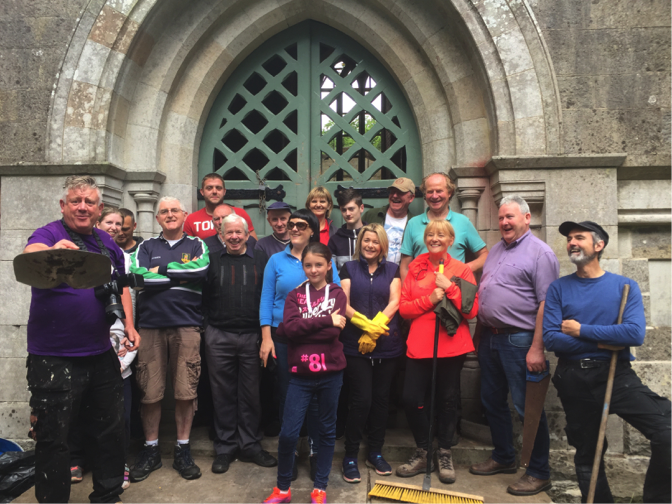
Volunteers pictured taking a break at a recent clean up at Rossmore Park
Rossmore Forest Park in Monaghan Town is a wondrous place for many – spending childhoods fumbling around between tree roots and over stepping-stones. A lot of us hold Rossmore so dear because of the nostalgia it resurfaces any time we visit. For these reasons, the people of Monaghan are very passionate about protecting and nurturing the park.
Dermot McNally of Transition Monaghan looks at our increasing detachment from nature as a result of our modern lifestyles which focus strongly on consumerism, urbanisation and automation, and have led to concern for our physical, emotional and mental health. Thankfully, pro-active reaction has led to the formation of many groups and activities to reinstate our connection with the surrounding natural world. In this article, Dermot explores the concept of ‘Forest Schools’ and how it could be applied in County Monaghan.
There is no doubt that today’s children are missing out on old fashioned outdoor fun and adventure. Could ‘forest schooling’ use nature as the place for learning as well as a playground for society’s youngest?
Ireland needs more native trees. Packs of trees for planting are now available as part of an initiative to plant one million trees in Ireland on just one day – Saturday 11 February 2017. If you are a landowner or a member of an organisation with suitable space, why not join in and order your trees – they are an ideal Christmas or New Year gift to our country, our planet, our children and future generations.
The not for profit group behind the initiative is called ‘One Million Trees in One Day’ and they provide the trees at a small charge. There are three types of tree packs that contain 50 trees per pack. There is a Woodland Pack, a Coppice Pack and a Hedge Pack and the vast bulk of the trees supplied are of native Irish provenance. Packs include appropriate mixes of oak, hazel, alder, rowan, birch, crab apple scots pine. Hawthorn and blackthorn are the main species in the Hedge Pack. Trees can be ordered online and are delivered to a location that is convenient for collecting them.
Many species of our wildlife such as the butterfly and the bumblebee are suffering a decline in numbers. As part of an effort to conserve our biodiversity, Monaghan Tidy Towns Network and the National Biodiversity Data Centre are inviting people to a FREE practical workshop on identifying the various species of butterfly and bumblebee we have in the county. It will also cover how to record sightings of these insects. The workshop will take place in Ballybay Wetlands Centre on Saturday, 28 May (10am-4pm).
When we think of a fine summer’s day in Ireland, the hum of bumblebees and the fluttering of butterflies probably spring to mind. Unfortunately today there are fewer bumblebees and butterflies in Ireland than in past decades with some species having become extinct and others heading in that direction. Undertaking surveys and taking action to improve the habitats of these insects is crucially important to the future survival of at least some of these species. Continue reading →
After the recent extreme weather events experienced here and in Britain there is now a lot of focus on the need for all of us to live more sustainably so that we don’t have runaway climate change and other ecological and social catastrophes. Sustainable living involves finding the right balance between utilising resources and protecting the planet. Some of the key elements of sustainable living involves reducing our carbon footprint and this has implications for many aspects of our lives including what we eat, the energy we use to heat our homes, our means of travel etc. There are many training course and initiatives in which we can participate that will give us skills to live more sustainably. This week we look at some of these in Ireland.
Co Monaghan was lucky to escape the worst effects of last week’s storm that hit the whole country. Developing community resilience is now regarded as important in helping deal with various types of emergencies that affect communities.
While we had a few fallen trees and slates from the recent storm, there was unfortunately the loss of of person’s life in the Midlands. For some people in other parts of Ireland there were power outages for a few days while others were left with no telephone or broadband services. The utility companies and some local authority and emergency services staff had to come out in the adverse weather to respond to the urgent situations that had arisen.
So what happens if communities are faced with emergencies be they from a natural or manmade diaster. A lot depends on the level of ‘community resilience’. ‘Cultivate’, the practical sustainability organisation, which is based in Cloughjordan, has been working on ways that community resilience can be developed. Davie Philip of Cultivate defines community resilience as the capability of communities to hold together, learn, adapt and maintain their ability to function in response to change. These changes can be sudden or slowly evolving. Davie sees the biggest challenge being our mind-set. Most of us don’t realise that we are never more than three days from running out of food – except you might only have a few days extra in your cupboard. Co-sufficiency rather than self-sufficiency is advocated. He sees the GIY (Grow it Yourself) movement and the increasing number of allotment projects as very welcome as they are examples of ways in which more people can have their own local food and also the skills to produce it – and so be more resilient. Developing community resilience can also be an enjoyable experience as people come together to share various skills and enjoy the fun and celebrations that form part of community projects.
The online UK book ‘Exploring Resilience in times of Rapid Change’ is a useful resource for communities looking at community resilience. It draws on the experience of emergency responses such as in the case of Hurricane Katrina in the US and explores the development of four key features of resilient communities: (1) healthy and engaged people. (2) an inclusive culture creating a positive sense of place.(3) a localising economy – towards sustainable food, shelter, housing shelter etc. (4) strong links to other places and communities. In recent years the use of social media has also been found to be extremely useful in helping communities in emergency situations.
In emergencies, individuals and of course our national and local authorties also have important roles to play. In a severe storm, individuals and families can be without power for many days. Heating and cooking become impossible or at least challenging for many of us. If we have a gas cooker or solid fuel stove (with no back boiler) it means we can boil some water. In order to be prepared for a storm it is advisable to have roof slates checked and also to a arrange for a professional assessment of tall trees that are near the house or roadside to see that they are not likely to be blown down in a storm. There are useful tips on tree safety in the ‘Roads / Severe Weather Information’ section of the Cork Co Council website www.corkcoco.ie. Detailed guidance on flooding can be found at www.flooding.ie while www.winterready.ie has useful guidance on dealing with adverse winter weather in the following contexts: home, road safety, health matters, schools, farming community and businesses. Businesses are directed to the Forfás document on ‘Business Continuity Planning in Severe Weather’.
The national authorities and volunteer support workers also play a major role in responding to emergencies. The website www.emergencyplanning.ie details the Irish Government’s plans for dealing with major emergencies. In the North East there is an inter-agency Regional Steering Group that has been formed for the Major Emergency Region of the North East. Monaghan Co Council has details on emergency planning on its website (under Fire & Building Control Section) including the ‘Preparing for Major Emergencies handbook’. In relation to the threat of a nuclear incident the Radiological Protection Institute of Ireland’s website (www.rpii.ie) describes the National Plan for Nuclear Emergencies.
The ‘Emergency Planning Society’ (www.the–eps.org) is an international organisation of emergency planning professionals and it has a branch in Ireland. Here in Ireland we also have our Civil Defence which in emergency situations supports Government agencies and the Emergency Services. It is a volunteer based organisation with 4,500 volunteers. For further details or to enquire about enrolling see www.civildefence.ie.
At various levels – be it at individual, family, community, business, local authority, national or international there is a need to have certain preparations in place to deal with emergencies. There are certain situations that we cannot prepare for. However there are ones, be they unexpected or slowly developing, that we can have certain strategies, plans, expertise, skills and resources in place to help our response ‘in the event of an emergency’.
MEG Member, Liam Murtagh who as a youth cut turf by hand for winter fuel, now reflects on the changing view of bogs and their role in maintaining biodiversity and combating climate change.




 Transition Monaghan