Campaign to stop treating soil ‘like dirt’

Soils across the world are being eroded and degraded and combined with climate change it poses a challenge for all of us. In Europe a new campaign has been launched to bring about an initiative to protect soils now and for future generations. In Ireland People4Soil and The Environmental Pillar have joined in the campaign to petition for a soil directive across Europe. To sign the petition go to http://www.environmentalpillar.ie/people4soil


People4Soil is concerned with the conservation of one of our most valuable non-renewable ppl 4 soil.pngresources: soil. We rely on soil to provide healthy food, clean water, support wildlife, store carbon, prevent flooding and ultimately to maintain livelihood across the world and here in Ireland. Ireland’s soils have come under increasing pressure from land use changes, intensification of agriculture, erosion and overgrazing, disposal of organic wastes to soils, afforestation, industry and urbanisation. Lost soil from these processes cannot be replaced and so we must protect them.

On RTE Radio the People4Soil spokesperson Klaus Laitenberger pointed out that the health of the soil in Ireland has deteriorated due to slurry spreading and compaction by heavy machinery. Worm populations have reduced since the traditional method of spreading farm yard manure has been abandoned. He said that farm supports in future should favour soil friendly farming.

WHAT CAN WE DO?

The primary goal of the campaign is to acquire sufficient signatures for a European Citizen’s Initiative. If the European Citizens’ Initiative surpasses 1 million signatures from seven different member states the European Commission will have to prepare and propose a Soil Directive. This directive would make countries protect soils in the same way that they already protect water, air and nature under previously existing directives.

A Soil Seminar was organised as part of the launch of the People4Soil campaign in Ireland and it took place on World Soil Day, on Tuesday last, 5 December. The venue was the Education Centre of the National Botanic Gardens in Dublin. Among the speakers were gardening author and People4Soil spokesperson Klaus Laitenberger, organic grower Nicky Kyle, Helen Kelly, Michael Ewing of the Environmental Pillar and Matthew Jebb Director of the Botanic Gardens

For more information on the People4Soil campaign see

http://www.environmentalpillar.ie/people4soil  and http://www.people4soil.eu.

December event can be found here

The ‘Transition’ of Irish Women

Collette Mc Entee of Transition Monaghan sees the presence of women at the decision making table as crucial. “We are half of the population and so our representation should reflect this,” she says. Collette attended and reports on the ‘Irish Women 1916-2116 Past, Present and Future’ event that took place at the Garage Theatre on Friday last. The event was hosted by Monaghan 5050, a group that strives to bring equality and a greater presence of women in electoral politics.

col.png

Collette Mc Entee

In this year of commemoration this event focused on inviting us to revisit and rethink the role of women in our society. A panel of four speakers, Ruth Taillon, Claire McGing, Mamo McDonald and Noirin Clancy led the discussion.

Minister Heather Humphreys opened the event and as one of just 35 women of 159 TDs (22%), she highlights the imbalance of our Irish voice. Humphreys actively campaigns towards this projected 50/50 ratio and has been appointing male dominated roles to women such as Chairperson of the National Museum of Ireland to Catherine Heaney and employing females as her drivers (Each minister gets two drivers. Humphreys is the only one to employ females in this role).

1916 PROCLAMATION – “EQUAL RIGHTS AND EQUAL OPPORTUNITIES”

2016 has been a commemorative year of the 1916 Rising and I feel more versed than ever on the events and its contributors. The year has also highlighted the inaccurate documentation of the female counterpart in the fight for Irish Independence. Ruth Taillon is the author of ‘When History Was Made: the Women of 1916’ (1996) which identified over 200 female contributors to the Rising and today, research continues with the figure over 300 and growing. Taillon looked back on 1916 and touched on the 1880s Suffrage movement to the Ladies Land League to familiar characters such as Maud Gonne and Jennie Wyse Power – female oppression deeply rooted in our past.


Gonne is an example of the inaccuracy shrouded over our female counterparts. Gonne actively took part and led the Inghinidhe na hÉireann, a radical Irish nationalist group from 1900-1914. However, how is she remembered? As W.B.Yeats’ muse. Our English curriculum in schools has this ingrained in our minds. Last year marked Yeats’ 150th birthday and the 21st December marks Gonne’s. Let’s celebrate that!

maud         Maud Gonne


Claire McGing, a lecturer at Maynooth University, delved into the role of women in politics. In 2012, the gender quota legislation passed and specifies that at least 30% of party candidates for general elections should be female and at least 30% should be male.  In 2019, the quota will rise to 40%. This quota echoes Ireland’s 2020 ‘energy targets’ plan with failure to comply resulting in financial loss. In this case, the political parties will risk losing half of their annual funding from the Exchequer under the Electoral Act 1997. At present, the Dáil has the most women in its history but female representation has yet to rise above 16%. Local elections are not included in this legislation. In local authorities there are few councillors who are women, especially in the more rural counties.

MAMO MCDONALD, A LOCAL LEGEND

Taking us down memory lane, Mamo McDonald, a former ICA president and local legend, painted a vivid picture of life as a woman of the 1950s onwards. McDonald begun with a few lines that were below a picture that hung in her childhood home;


It’s the little things that count…

Big things are very little after all

fame, fortune, reputation

are as dead sea fruit

without the background of a happy home

mamo

Mamo McDonald

Her account supported all those tales my grandparents have recounted to me of their simple yet happy, difficult yet fondly recalled lives. It also highlighted how far we have come and how much quicker we can get there today. In this whirl of advancement, change is accelerating. Rather than cower in a corner ridden with nostalgia for the simpler times, let’s use it to our advantage. A world of equality is within our sight.

The morning concluded with a thought provoking forecast of 2116 by Noirin Clancy, a 5050 representative. Clancy works part time with Longford Women’s Manifesto Project and showed us a really evocative video set in 2116 which predicts an Ireland of equality – 60% women representatives in the Dáil (with a push to reduce this back to equalise the ratio), a crèche in place of the bar in Leinster House, a safer Ireland with nearly 0% domestic violence.

“IT’S THE LITTLE THINGS THAT COUNT”

Today, it can be overwhelming to digest the current global upheaval characterised with accelerating climate change, the election of Donald Trump, technology advancements, Brexit and much more. Resilience and respect are key. As life and the world chugs on, we have to keep defending what we have already won. Respecting each other and our world will encourage our growth as a society and as a healthy, sustainable world.

‘It’s the little things that count…’ resonated with me as it’s becoming increasingly difficult to figure how I and Monaghan can contribute. Taking a small portion of the problem ourselves and working collectively will bring ideas to realisation. Monaghan is a little place but it counts.

Events in December can be found here

Low Carbon Transition: How could it benefit our mental health?

Fortunately, we live in an age where stigma is being lifted around mental health. However, conditions such as depression, anxiety and stress are on the rise in Ireland. Anti – depressants and therapy play an important role in helping people deal with and overcome these issues. While there are many causes of mental illness, in recent times more attention has been paid to the connection between a more sustainable lifestyle and positive mental health. Mícheál Callaghan discusses how the Transition to a low carbon future can be good for the planet and our mental health.

Many people today have to work long hours, sometimes at unsociable times of the day, in jobs they don’t find particularly fulfilling. Wages have been cut across sectors, people are being replaced by machines (e.g. self – service check outs), and the cost of accessing basic services such as health and child care are going up. People are under more pressure and stress. After work we might come home and spend the night in front of the TV. We’re as likely to spend time scrolling our social media feeds than talking to other people. We are less connected to our neighbours and communities than before. Small rural shops and post offices, which once were important meeting places, are closing down. Our fast paced world places more emphasis on individual identity than togetherness. Not only is this terribly sad, but it’s also bad for us. Loneliness is becoming a chronic condition among all ages, especially among the elderly. According to recent research, one in three adults over 65 suffers from loneliness and this doubles their risk of dying. Loneliness kills, and this cannot continue!

black-island-walk

A sign for one of the walks on the Black Island, Lough Muckno, Castleblayney

We are also less connected with the natural world than ever before. More and more people are living in large towns and cities. Many young people from Co. Monaghan head off to cities for college and work. Nature is being destroyed. Even those of us living in the countryside, might not stop to appreciate the beauty of the natural world. Research has shown that our brains react differently to an image of the natural environment compared to the urban environment. It instantly recognises the natural environment, but has to exert more energy to ‘understand’ the unnatural urban world. Spending time in nature is proved to reduce stress and depression. Coming up to Christmas, as we move from Autumn to Winter, we can take a break from the pressure to shop by going for a walk in the woods (Rossmore Park, Lough Muckno or Dartry Forest are fantastic amenities!) and enjoying the crisp air and sound of crunching leaves. Sometimes only when we pause, can we reflect on the various pressures that are on us at this time of year.

RECONNECTING AS WE TRANSITION TO A LOW CARBON WORLD

Connecting with those around us and the natural world can really help us deal with the ups and downs of life. Our fast paced, economic growth obsessed world can fail to recognise the importance of these to our well – being. The transition to a low carbon society, must be one which reassesses how we measure progress. The transition town model, aims to strengthen our sense of community and build resilience as we move to a world which uses less fossil fuels.

If we are going to make this transition successfully we are going to have to collectively plan the future of our communities. It will offer more social interaction and increase our dependence on each other taking us out of our individual silos. Initiatives like community gardens, allotments, community energy projects and other community social enterprises will have a role in this transition. Leading sustainability economists recommend shorter working hours and more time spent with family, friends and community. This transition can build personal resilience by making us more connected with each other, and community resilience by once again emphasising our dependence on each other and the diverse skills that exist in our communities. We can open our eyes to the many talents that our neighbours have, and exchange our skills and knowledge. The transition will also offer opportunities to get closer to nature. It stresses the importance of protecting our biodiversity, creating community gardens and planting fruit and nut trees. Initiatives like Monaghan Allotment Society, Castleblayney Community Gardens and Monaghan Tidy Towns are already doing this. Why not join the community transition by in one of the initiatives above or a similar initiative in your area or get in touch with Transition Monaghan? Email transitionmonaghan@gmail.com.  Together we can protect our community ties, build social capital, and create healthier and happier communities. Not only will it be good for our planet, but good for our health too!

December events can be found here

If Trump steps back on climate action, will the rest of us step up?

Shockwaves reverberated throughout the globe on Wednesday 9 November as people woke up to the news that Donald Trump had been elected the 45th US President. Many negative reperussions are feared from this outcome. Jennifer Mc Aree of Transition Monaghan elaborates below. As we hear that 2016 will be the hottest year on record she focuses on the Trump’s threat of inaction on climate change and what we can do to counteract it.

Jennifer Mc Areejma.png


Like most people I was astounded at the US Presidential election results. The belief many held that Hillary Clinton would shave past Donald Trump to become the first female US president unfortunately did not transpire. It was like Brexit, but bigger!

Donald Trump has continuously objectified and insulted women, incited hatred for non-white people and ridiculed homosexuals. For this he received rapturous applause from devoted fans who are basically fearful and disenfranchised citizens. A sinister movement of white supremacy, sovereignty and obsession with infinite economic growth has arisen in the US once again. Thus the fanfare for Trump’s slogan: “Let’s make America great again!” The Brexit campaign also revealed some of this ethos and such tensions continue to grow across Europe.

In environmental terms, Trump could be catastrophic to the fragile progress made on climate action in the US. He has declared that climate change is a “hoax” created by the Chinese in order to damage the US economy. He has vowed to scrap promises made by Barack Obama after last year’s historic COP21 Paris Agreement and his Clean Power Plan, which aims to gradually replace dirty, climate damaging coal plants with renewable energies such as wind and solar power. Hillary Clinton adopted certain polices espoused by Senator Bernie Sanders such as support for clean energy, declaring that the US could become a green energy leader and create millions of new jobs in the process.

PANDERING TO THE OIL AND COAL COMPANIES

Instead Trump has won out, in part by pandering to the big oil and coal companies. Blue collar workers who fear further job losses through the shutting down of coal-powered plants have supported him. Trump wants to reduce the powers of the American Environmental Protection Agency (EPA) and place fossil fuel sympathisers in influential positions. The Republican Party already dominates the Senate. It is no secret that several of its members get support from the oil industry and are staunch climate deniers (in other words they reject the overwhelming scientific evidence that this period of climate change is manmade). It is ironic that here in Ireland this week is ‘Science Week’ – and some events in Cavan-Monaghan are actually on the climate change topic!

SUPPORT FOR ‘STANDING ROCK’ PROTEST

Trump is now likely to plough ahead with two massive oil pipelines (Keystone XL and the Dakota Access Pipeline). These have been stalled to date due to protests at ‘Standing Rock’ by environmentalists and local communities including Native Americans. They claim that it will threaten water supplies and sacred Native American sites and ultimately contribute to climate change. Some environmentalists in Ireland have highlighted the fact that the Choctaw tribe in the US raised money to send to Ireland at the height of the Famine and that now it is our turn to support such native communities.

WHAT WILL CHINA, INDIA AND IRELAND DO NOW?

So how does this election result affect us here in Ireland? Well, the USA is the second biggest carbon emitter in the world after China. Where America leads, many follow. Both superpowers have been making promising strides towards the green agenda under Obama’s encouragement. If Trump backtracks on this fragile progress, many nations such as India and China may ask why they should take further climate action when the US continues to burn fossil fuels as always. India currently depends on inward investment to develop renewable energies, but if Trump refuses (as threatened) to donate the billions Obama promised to struggling nations affected by climate change, what is the alternative?

Before we can gloat however, Laura Burke of the Irish EPA (Environmental Protection Agency) has just reported that Ireland will breach its binding greenhouse gas limits for 2016 and 2017 after a surge in greenhouse gas emissions across the transport, energy and agriculture sectors last year. We are likely to breach the EU 2020 targets, which will cost the Irish state €300 million in EU fines per year onwards.

lbLaura Burke, Director General, EPA


Is there any hope in all of this? Surprisingly, yes. A strong anti-fossil fuel movement is present and growing across the globe. Wind and solar energy are becoming more widespread and affordable. More countries are now aware of the effects of climate change on their own doorstep and want to act. Donald Trump may even be the catalyst we all need to fight further for a safer climate, a fairer society and a more sustainable economy. We can lobby our Government to do more in Ireland. We can further develop renewable energies, support local food producers, reduce meat consumption and focus on minimising energy use and needless materialism and waste. Time will tell how Trump will affect America and those of us further afield. I leave the last word to American climate scientist Dr Philip B. Duffy: “If the United States Government steps back then others will have to step up.”

Click here for a list of events in December

A “serious wake-up call”: Climate Council’s report

climate-change-advisoryThe new Climate Council’s first Report was released last week and has important news for all of us.  We look at the report and some reaction to it. We also feature what the coalition of groups known as ‘Stop Climate Chaos’ says needs to be happen immediately if we in Ireland are to play our part in dealing with the greatest threat facing humanity.  This comes as the Paris Climate Agreement comes into effect and the next round of UN climate talks begin in Marrakesh.


The Climate Change Advisory Council is an independent advisory body tasked with assessing and advising on how Ireland can achieve the transition to a low carbon, climate resilient and environmentally sustainable economy.  In the first report of the Council its chair Prof John Fitzgerald said that Ireland should aim to have “no further negative influence on the Earth’s climate system by the middle of this century”.  Not surprisingly the report goes on to say that Ireland may not meet its 2020 targets and may not be on a pathway to meet its 2050 goals. Ireland’s national goal of an 80% reduction in carbon emissions and carbon neutrality in agriculture will require “major societal and economic transformation.   Ireland’s progress to reduce emissions they say are “at best mixed” and add that they are of “considerable concern”

john-fitz

Prof John Fitzgerald


On specific sectors the report highlights the benefits for everyone of energy retrofits to homes with health and cost-of-living benefits as well as emission reductions. The Council emphasises that “progress in tackling transport emissions has been very limited” and highlights that “agriculture will need to outline a pathway to [carbon] neutrality in 2050”.

 A SERIOUS WAKE-UP CALL

oisin


 Friend of the Earth’s Oisín Couglan welcomed the report but said that it should come as a “serious wake-up call for the government,” He goes on to ask: “Does it fully capture the urgency if we are to fulfil the goals of the Paris Agreement? No. But this is a good day for transparent, evidence-based policy-making. The report is a serious-minded effort to frame the climate action challenge for Government. We’ll see when the Government publishes its draft action plan are they up to that challenge.”

Oisín Coughlan

A RAPID AND JUST TRANSITION TO A CARBON–FREE FUTURE

According to Stop Climate Chaos there are a number of immediate decisions thastop-climate-chaost the Government can make to show it is getting serious about climate action. We reproduce the Group’s three proposals below.

  1. Enabling community ownership of renewable energy

 As a first step we’re demanding the Government guarantee a fair payment for solar electricity so that people get paid for the excess energy they generate with panels on the roofs of their homes, farm buildings, schools, clubs and community halls, and from the electricity generated in solar farms, rather than having to give it away for free.

  1. Divesting taxpayers’ money from fossil fuels

 To continue to invest in fossil fuel companies is to encourage and enable their plans to continue to explore and extract more and more fossil fuels – when even burning all that we already have would make the Paris commitments impossible. Divesting the Ireland Strategic Investment Fund (ISIF) from fossil fuels and adopting a 100% renewables investment policy for energy investments by the Fund is the responsible and the moral option. These should be key recommendations emerging from the ongoing review of the ISIF investment strategy.

  1. Achieving the goals of the Smarter Travel policy

 Transport is the only sector where emissions are still higher than they were in 1990. They almost tripled from between 1990 and 2007. They are rising again quickly now. We are calling on the Government to commit the resources needed to achieve the goals of the Smarter Travel Policy for 2020. That means at least 20% of transport funding to go to walking and cycling and at least 50% of transport funding to go to public transport.

In conclusion, Stop Climate Chaos says that ultimately, the measures we adopt need to add up and need to be consistent with a decent chance of limiting global warming to well below 2°C. The group says that nobody is asking Ireland to do more than its fair share but “we do expect Ireland to do its fair share.”

 Events guide for November can be found by clicking here

December’s event guide can be found here

Glimpses of hope for a sustainable future

Fracking ban here and a marine park in Antarctica

Last week Michael Connolly and Liam Murtagh, of Transition Monaghan attended a workshop in Dublin entitled, ‘Managing Despair, Cultivating Hope: Responding Positively to the Challenge of Climate Change and the Environmental & Economic Crises We Face.’ Around the same time the Dáil voted to ban fracking and ratify the Paris Climate agreement. Liam now writes about a week of ‘hope’ that also included the announcement of an international agreement to create a marine park in the Antarctic.  

                                     Liam Murtagh                            Michael Connolly


‘MANAGING DESPAIR AND CULTIVATING HOPE’

The emotional response of individuals to impending global ecological disasters was the subject of a workshop facilitated by John Sharry, Psychologist and John Gibbons an environmental journalist. They pointed out that like in any emotional crisis the best approach is to accept the reality we find ourselves in – probably after a period of denial and despair. The next step is to create a meaningful vision of how to live in the face of such reality. After that we need to focus on constructive action and also – and very importantly – we need to build or link to a community of support around us.

.

john-sharryJohn Sharry, Psychologist


The session had a hopeful dimension as many of those attending shared stories of the success of various sustainability projects – from GIY projects to energy saving and nature conservation initiatives.  Building ‘resilience’ in communities was explored as a way to cope with any future unexpected shocks.  A detailed report on the workshop is at http://www.thinkorswim.ie.

john-gibbonsJohn Gibbons, Journalist


NO FRACKING FOR MONAGHAN

Last week the no-frackDáil gave unanimous backing to a Bill that will prohibit the extraction of oil and gas from areas in Ireland where it would need to be fracked to be taken out of the ground. This would include County Monaghan. The threat to the ground
water was one that was of particular concern to many people while Friends of the Earth hailed the Dáil vote as “an historic first step towards a fossil free future”.  The decision on fracking came on the same day the Dáil voted to ratify the Paris Agreement on climate change. Both decisions have been widely welcomed.


ORIGIN GREEN AWARD FOR MONAGHAN DAIRY FARMER

Some recent positive news on sustainability in farming in Co Monaghan was the winning origin-greenby Dermot Sherry, Drumhillock, Monaghan of Bord Bia’s Origin Green Awards in the Liquid /Winer Milk category. Dermot’s and the other award winners nationwide are to be congratulated.


Bord Bia has come in for criticism for their support for the massive expansion of the dairy and beef herd – because of the consequent increased emissions and also for the marketing of infant formula milk to Chinese mothers which it  is claimed discourages breastfeeding. On the other hand, initiatives that promote sustainability and give recognition to genuine emissions reductions in farming are welcome. Another agri sustainability initiative is Teagasc’s Carbon Navigator which is an online emissions reduction tool for farmers.

WHY WELCOME ANTARCTICA’S MARINE PARK?

Internationally last week bought news from the ‘Living Planet Index’ that we are on track for a two-thirds decline of the number of wild animals and fish in the half-century from 1970 to 2020.  Oceans are at particular risk. Separately we also heard of a decision to create a 1.5m sq km marine park in the Ross Sea around Antarctica. The area provides important nutrients to all the world’s oceans.  No fishing will be permitted in these pristine waters. It is hoped that this will be the first of more marine parks that will help address the problem of the declining health of our oceans and the wildlife that depend on them.

penguinPenguins and other wildlife will benefit


LOOKING AHEAD

As we saw in recent weeks the news of impending challenges facing humanity – and us in Ireland can be ignored or denied. Alternatively people can take collective action, be it through voluntary groups or at a political level – and this can make a difference. The challenge is that many more people need to be involved in such action.    

A list of events on in November can be found by clicking here

NEWS ITEMS

FREE SUSTAINABLE LIVING COURSE IN DUNDALK


Do you want to learn more about how to use water and food more sustainably? Would you dp.pnglike to learn a bit about renewable energy? Why not sign up to the 6 week course, one evening per week, starting in O’Fiaich College, Dundalk on Monday, 7 November. The course is being organised by Development Perspectives – a Development Education organisation based in Drogheda. For details see http://www.developmentperspectives.ie/get-involved. Contact garethconlon@outlook.com for more info.


RATIFICATION OF PARIS AGREEMENT EXPECTED: WHAT THEN?

copMinister for Communications, Climate Action and Environment Denis Naughten now plans to seek the approval of the Dáil for ratification of the Paris Agreement on global climate change. The next United National global summit on climate change is being held in Marrakesh, Morocco in November and it is the aim of the Government to have the Agreement fully ratified by Ireland in advance of the summit.

The move has been broadly welcomed as it had been thought that the Government was planning to delay ratification until negotiations with the EU on emissions targets for 2030 relating to agriculture were concluded. The challenge now is to implement actions that will substantially reduce Ireland’s climate damaging emissions – they are now increasing rather than decreasing.


The campaigning coalition Stop Climate Chaos is inviting people to contact their local TD stop-climate-chaosand if possible meet them on Tuesday, 15November in Buswells Hotel,   opposite the Dáil, to discuss Ireland’s plan to tackle climate change. According to Heather Mason, the Group’s coordinator,  the focus of the day is “the challenges and opportunities for Ireland in the rapid and just transition to a carbon free future that is now imperative” They go on to say it requires the Government “to adopt a climate action plan in the next 9 months.” For details see http://www.stopclimatechaos.ie.

 DÁIL TO BAN FRACKING?

Fracking is the term for extracting shale oil and gas from deep under the ground. The process involves pumping millions of gallons of water mixed with sand and toxic chemicals deep into the ground at explosive pressures. According to Friends of the Earth this process has serious negative impacts on the environment and the health of communities nearby. Particularly unacceptable they say is the contamination of surface and groundwater, including drinking water so for our health, for our land, and for our water fracking is bad news…but above all else fracking is bad for the health of our climate.

Later today (Thursday) there is a Bill to ban fracking in Ireland scheduled for debate in the Dáil. It is being put forward in ‘Private Members Time’ by Fine Gael TD for Sligo – Leitrim Deputy Tony Mc Loughlin.  Most political parties have either a stated policy or declared in their election manifesto’s that they are opposed to fracking.  Friends of the Earth and other anti-fracking campaign groups hope that there will be enough support in the Oireachtas for the Bill to be passed.

tony

Tony McLoughlin TD, Sligo-Leitrim  

CAMPAIGN FOR CLIMATE LEGISLATION IN THE NORTH

Northern Ireland is the only part of the UK not fully covered by the 2008 Climate Change Act, or complementary devolved legislation. Three groups, Christian Aid, Trocaire and Friends of the Earth, Northern Ireland have come together to highlight the issue. According to the coalition of campaigning groups this means that the Assembly has not committed to ensure that Northern Ireland does its fair share to meet global emissions reductions agreed in Paris in December 2015.

On Monday, 14 November, as the UN climate talks take place in Morocco, the Groups and supporters will be heading to Stormont to tell the politicians that they are letting the people of Northern Ireland and the planet down by not legislating for a carbon free future. Tickets are required for anyone who wishes to go along to support the groups. See the Facebook page ‘Dear Stormont, We Want to Talk about Climate Change’ or search for the event on Eventbrite.

November events can be found by clicking here

Climate Action: A good start, or too little, too late?

Budget 2017’s Environment, Energy and Climate Action Measures

 Recording breaking temperatures worldwide, devastating hurricanes like the recent one in Haiti, drought in the countries of Southern and Eastern Africa and rising sea levels on low-lying islands in the Pacific are all indicators of the impact of climate change. Ireland is one of the countries whose climate damaging emissions are among the highest per person in the world.  It is debatable if the measures in Budget 2017 will have any significant impact on helping us reach our emissions reduction targets.      

On the positive side the Budget had some welcome developments that will be implemented by Department of Communications, Climate Action and Environment. Among these is the plan to set up a ‘National Dialogue on Climate Change’. There were a number of other measures in the area of energy efficiency and the continuation of VRT relief on new electric vehicles. Further details are available in the press release at http://www.dccae.gov.ie.

Denis Naughten.jpg

Denis Naughten, Minister for Communications,

Climate Action and Environment.

THE CHALLENGE

 The burning of coal, oil and peat for electricity generation is still is a big contributor to Ireland’s high emissions – Budget 2017 changes nothing on this score. Agriculture is also a huge emitter of damaging greenhouse gases. While funding was approved for new GLAS scheme (Green Low-Carbon Agri-Environment Scheme) – and this will have some positive environmental impact – there is not enough being done to deal with emissions from the beef and dairy sectors.

What was also missing from Budget 2017 was a focus on more support for public transport that would encourage people to make more use of trains and buses and less use of cars. The investment in public transport is not enough to make an adequate impact on emissions from transport. There was no mention of a move towards electrification of trains and urban buses or even more cycle ways.

Separate from the Budget we hear that the Government will delay Ireland’s ratification of the Paris Climate Agreement until negotiations on 2030 EU emissions targets from agriculture are concluded. Time will tell the extent to which we in Ireland will play our part in dealing with the greatest challenge ever facing humanity. The people of Haiti are suffering the effects of a hurricane Matthew – over a thousand deaths and houses and schools destroyed. Climate change will mean more frequent and more severe hurricanes.   You can help provide some immediate support to the people of Haiti by donating to Concern’s Haiti Hurricane Appeal. See ‘Donate – Appeals’ at http://www.concern.net.

A link to the November noticeboard can be found by clicking here

Grow HQ to be hub for a food ‘revolution’

GIY groups celebrate at new centre in Waterford

Last weekend local food was the focus not just at the Taste of Monaghan but also at the opening of the GIY (Grow it Yourself) HQ in Waterford. Liam Murtagh of Transtition Monaghan and also of Castleblayney Community Gardens Group went along to a gathering of ‘GIYers’. They were there to view the facilities at Grow HQ and meet the team of people who wll lead the revolution that is needed in reconnecting people with growing, cooking and eating local food.  

grow hq.png  

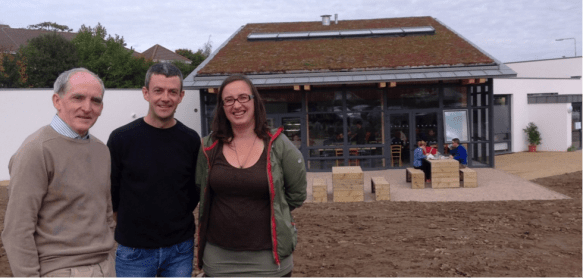
Pictured at the opening of the Grow HQ in Waterford were Liam Murtagh, (Transition Monaghan,) Michael Kelly (Founder of GIY) and Lucy Bell, Master Grower at GIY HQ. The new Grow HQ with its green roof is in the background.

Michael Kelly was an IT professional who one day during his shopping trip bought a bulb of garlic. He happened to notice that on the supermarket’s price tag that China was given as the country of origin. He knew from his little knowledge of vegetables that garlic can be grown in Ireland so why, he asked himself, was he buying garlic that had travelled thousands of kilometres from China. This was Michael’s first lightbulb moment. He started on a journey of growing food at home and going on to found the GIY movement – an organisation dedicated to growing and promoting home grown food.

The latest stage in the GIY journey has been the completion of the €1.4m Grow HQ. It’s located near University Hospital Waterford and the Solas Cancer Centre. . Michael Kelly says that this is intentional as both the hospital and GIY are about health – one focused on treatment of disease and the other on prevention. The facilities at the Grow HQ currently include a restaurant, a shop and training rooms. Even though the grounds have only been available to GIY for growing for the past few months Lucy Bell and her team have been growing and harvesting vegetables and herbs. Many demonstration gardens have yet to be developed.

The visiting GIYers were given a tour of the gardens and a lunch comprising beetroot soup and Waterford blaas (bread rolls) along with a combination of food from the gardens and locally grown food. The event also featured the national final of the GIY Spúd Off – a potato growing and cooking competition. The winner was Gavin Mauder from Cork who grew his ‘Pink fir apple’ variety of potatoes in a bag. One of the adjudicators was Aoife Aherne, Bord Bia’s Potato Ambassador and also a panellist on RTE’s Operation Transformation. She reminded everybody of the importance of having unprocessed carbohydrates in our diet and potatoes are the ideal choice.

mixhael-kelly

Michael Kelly, Founder of GIY gives GIYers a tour of the new gardens at GIYs Grow HQ


The GIY day at Grow HQ included announcements of a number of new GIY campaigns. These include an Orchard in an Hour Campaign   which will involve five fruit trees being given free of charge to the first 100 groups who apply. An announcement of a new phase of the funding under the Get Ireland Growing Fund which will support community growing projects around Ireland. The development and support of ‘cottage markets’ around the country is another project which is being developed by GIY. The motto of cottage market motto is ‘homegrown, homemade and homecrafted’.

The day concluded with an announcement of the various new one day courses which will be delivered at Grow HQ. New GIY groups are always welcome to join the GIY network. The GIY website has plenty of tips for anyone who wants to grow their own. So why not start your own GIY journey now by buying some garlic and planting it now for harvesting next year. Check out http://www.giyinternational.org.