Untethered Writing and Whining with poetry & puns by Dermy McNally.
My writing has been in publication since 2001 in publications such as The Northern Standard, The Irish Times and TheJournal.ie. My writing is a mixture of short fiction, journalism, opinion pieces, poetry, radio plays and more.
Jennifer McAree of Transition Monaghan was one those selected by the Tipperary Energy Agency for a green trip to Bursa in Turkey. The trip took place last month. Here Jennifer reports on the background to the project as well as the trip itself, which she describes as a “brilliant experience”.
On a Green Trip to Turkey were: (L-R) Alex Hamilton, Tipperary Energy Agency, Trisha Purcell, Drombane Village Group, Cemal Yagci, Turkish representative and guide, Jennifer Mc Aree, Transition Monaghan and David Phelan, RPS.
Members of the public were being invited to an event entitled ‘Your Cost Efficient Home’ which was held in theMarket House, Monaghan on Saturday, 25 April 2015. The focus was on how to reduce your energy, water and waste bills. There were two key note presentations by experts in the area of low energy in the home – Michael Hanratty of Energy Action and Frank Cooney of Cooney Architects. The presentations were followed by workshops on Heating / Insulation, Electricity, Composting and Water and were ran by Jennifer McAree, Ollan Herr, Michael Connolly and Barry Mc Carron respectively.
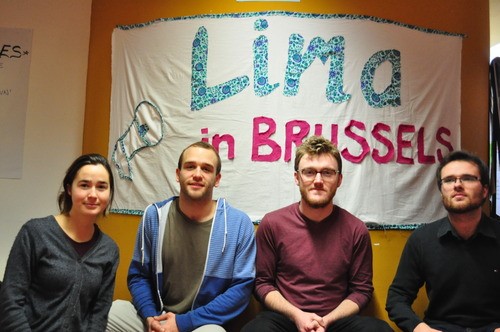
Two members of Transition Monaghan recently met with Irish MEPs while attending events in Brussels related to climate change, sustainability and Free Trade.
Selection of Attendees of ‘Lima in Brussels’ event (L-R): Ciara Kenny (Dublin), Áron Bányász (Hungary), Robert Wade (Dublin) and Mícheál Callaghan (Monaghan).Continue reading →
After the recent extreme weather events experienced here and in Britain there is now a lot of focus on the need for all of us to live more sustainably so that we don’t have runaway climate change and other ecological and social catastrophes. Sustainable living involves finding the right balance between utilising resources and protecting the planet. Some of the key elements of sustainable living involves reducing our carbon footprint and this has implications for many aspects of our lives including what we eat, the energy we use to heat our homes, our means of travel etc. There are many training course and initiatives in which we can participate that will give us skills to live more sustainably. This week we look at some of these in Ireland.
The beautiful Ballybay Wetlands Centre provided a very suitable location for a weekend of discussions and workshops on living sustainably. The sun shone on the drumlins surrounding the Dromore River, and the birds gently tweeted as Marella Fyffe, from Omagh Co. Tyrone, led Transition Monaghan’s weekend workshop on Sustainable Living Skills / Permaculture.
We have a renewable energy source which is largely untapped in Ireland. Anaerobic Digestion (AD) is a great story to tell. It takes slurry and surplus agri waste as well as certain types of waste currently sent to landfill and turns it into renewable energy. It also produces an organic fertiliser. The technology is proven and widely used across Europe. Here are some questions and answers about AD and its potential use in Ireland.
Co Monaghan was lucky to escape the worst effects of last week’s storm that hit the whole country. Developing community resilience is now regarded as important in helping deal with various types of emergencies that affect communities.
While we had a few fallen trees and slates from the recent storm, there was unfortunately the loss of of person’s life in the Midlands. For some people in other parts of Ireland there were power outages for a few days while others were left with no telephone or broadband services. The utility companies and some local authority and emergency services staff had to come out in the adverse weather to respond to the urgent situations that had arisen.
So what happens if communities are faced with emergencies be they from a natural or manmade diaster. A lot depends on the level of ‘community resilience’. ‘Cultivate’, the practical sustainability organisation, which is based in Cloughjordan, has been working on ways that community resilience can be developed. Davie Philip of Cultivate defines community resilience as the capability of communities to hold together, learn, adapt and maintain their ability to function in response to change. These changes can be sudden or slowly evolving. Davie sees the biggest challenge being our mind-set. Most of us don’t realise that we are never more than three days from running out of food – except you might only have a few days extra in your cupboard. Co-sufficiency rather than self-sufficiency is advocated. He sees the GIY (Grow it Yourself) movement and the increasing number of allotment projects as very welcome as they are examples of ways in which more people can have their own local food and also the skills to produce it – and so be more resilient. Developing community resilience can also be an enjoyable experience as people come together to share various skills and enjoy the fun and celebrations that form part of community projects.
The online UK book ‘Exploring Resilience in times of Rapid Change’ is a useful resource for communities looking at community resilience. It draws on the experience of emergency responses such as in the case of Hurricane Katrina in the US and explores the development of four key features of resilient communities: (1) healthy and engaged people. (2) an inclusive culture creating a positive sense of place.(3) a localising economy – towards sustainable food, shelter, housing shelter etc. (4) strong links to other places and communities. In recent years the use of social media has also been found to be extremely useful in helping communities in emergency situations.
In emergencies, individuals and of course our national and local authorties also have important roles to play. In a severe storm, individuals and families can be without power for many days. Heating and cooking become impossible or at least challenging for many of us. If we have a gas cooker or solid fuel stove (with no back boiler) it means we can boil some water. In order to be prepared for a storm it is advisable to have roof slates checked and also to a arrange for a professional assessment of tall trees that are near the house or roadside to see that they are not likely to be blown down in a storm. There are useful tips on tree safety in the ‘Roads / Severe Weather Information’ section of the Cork Co Council website www.corkcoco.ie. Detailed guidance on flooding can be found at www.flooding.ie while www.winterready.ie has useful guidance on dealing with adverse winter weather in the following contexts: home, road safety, health matters, schools, farming community and businesses. Businesses are directed to the Forfás document on ‘Business Continuity Planning in Severe Weather’.
The national authorities and volunteer support workers also play a major role in responding to emergencies. The website www.emergencyplanning.ie details the Irish Government’s plans for dealing with major emergencies. In the North East there is an inter-agency Regional Steering Group that has been formed for the Major Emergency Region of the North East. Monaghan Co Council has details on emergency planning on its website (under Fire & Building Control Section) including the ‘Preparing for Major Emergencies handbook’. In relation to the threat of a nuclear incident the Radiological Protection Institute of Ireland’s website (www.rpii.ie) describes the National Plan for Nuclear Emergencies.
The ‘Emergency Planning Society’ (www.the–eps.org) is an international organisation of emergency planning professionals and it has a branch in Ireland. Here in Ireland we also have our Civil Defence which in emergency situations supports Government agencies and the Emergency Services. It is a volunteer based organisation with 4,500 volunteers. For further details or to enquire about enrolling see www.civildefence.ie.
At various levels – be it at individual, family, community, business, local authority, national or international there is a need to have certain preparations in place to deal with emergencies. There are certain situations that we cannot prepare for. However there are ones, be they unexpected or slowly developing, that we can have certain strategies, plans, expertise, skills and resources in place to help our response ‘in the event of an emergency’.
MEG member Liam Murtagh went along recently to a special seminar entitled ‘Climate Justice begins at Home’ – an event held to coincide with the Mary Robinson Foundation’s international conference in Dublin, ‘Hunger – Nutrition – Climate Justice 2013’ The seminar was organised by Friends of the Earth and Food Sovereignty Ireland.
Cecilia Kibe from Kenya was just one of the many grassroots community members from the developing world who had travelled to the Dublin conference to represent their communities. The conference aimed to focus the eyes of the world and in particular the attention of decision makers on the injustice of climate change – a situation in which the people who have not caused climate change are the ones who are suffering the most from its effects. At the seminar Cecilia described how climate change is being primarily caused by the burning of fossil coal and oil in the developed world and that it is setting back the efforts to address the Millenium Development Goals in the developing world. She outlined the impact of droughts on food production in East Africa and also the effects of land erosion which happens in certain areas when there are downpours following long periods of drought.
On Thursday 6 November 2013, Monaghan Ecological Group hosted a free film screening of “Chasing Ice” in the Market House, Monaghan, at 7:30pm.
Chasing Ice is a compelling film which charts the work of photographer James Balog, who began tracking changes in Arctic Ice in 2005, by placing a number of cameras at different locations across the arctic. Through photographs and videos, Balog built up spectacular time lapse images and videos of changes to arctic sea ice, including the capturing of dramatic ice cavings, when large chunks of ice break off into the sea. The result is indisputable evidence of the dramatic pace of arcitc ice melt in recent years. The film provides moving and compelling evidence of man made climate change.
Monaghan Ecological Group is working with local organisation, LETS TRADA to develop a Local Exchange Trading Scheme in Clones. Such a scheme would encourage local trade, keep people in work and contribute to building a resilient community. Mícheál Callaghan in discussion with Ciarán Fitzpatrick examines how this scheme will work and the benefits that it will bring to the Clones area.
The new logo for LETS Trada, Local Exchange Trading Scheme





 Transition Monaghan