Showtime for local and sustainable food

Community gardeners (from left) Máire Brehony, Deirde McGinn, Helen Mooney and Eileen Kerr checking their tomato crop at the community polytunnel at Eagle Ridge Gardens, Drumillard Castleblayney.

Community gardeners (from left) Máire Brehony, Deirde McGinn, Helen Mooney and Eileen Kerr checking their tomato crop at the community polytunnel at Eagle Ridge Gardens, Drumillard Castleblayney.

The local Shows such as the recent one in Castleblayney was an opportunity for locally produced food and craft to be exhibited. As well as the competitions for horticultural and food produce there was the new Food Village – ‘From Field to Fork’ with stalls where  producers of a wide range of  local foods,  ranging from jams to sausages, displayed and sold their produce.  Castleblayney Community Gardens had a stand there displaying their fruit and vegetable produce from their community gardens. Some of the vegetables and herbs at their stand were using in the cookery demonstration in the Food Village. Elsewhere at the Show there were a number of stands of interest.  One of these was that of the cross border chapter of the Irish Woodturners Guild. They had a wide range of locally sourced and crafted wood products ranging from a fruit bowls to a traditional spinning wheel. Local sustainable produce has always been a feature of these annual Shows and it is great to see this element being further expanded this year by the committee of the Castleblayney Show Society.  Tydavnet Show takes place this Saturday 15 August at the showgrounds at Drumshevra, Scotstown. Why not go along and see the range of local produce on display.  More details are available elsewhere in this newspaper and at http://www.tydavnetshow.ie.

Recognising the true value of nature and biodiversity

In today’s fast paced world, where almost everything is valued in monetary terms, it is easy to forget the true value and importance of that which sustains us – the natural world. Water, air, fuel and food are probably the most important elements of survival, all of which come from nature, and allow us to prosper. Of course, some of these resources are finite and others, such as water and air, become less useful if polluted. How we interact with these resources has an effect on their quality as well as our own health. As human beings, we have a responsibility to ourselves, the planet and future generations to act as stewards and take care of the natural world, so that our children and children’s children can continue to enjoy nature’s bounty.

Biodiversity garden at Glaslough

Biodiversity garden at Glaslough

Biodiversity loss

Unfortunately, we haven’t been doing a great job at protecting our natural environment. Our biodiversity, has suffered a great decline in recent years with continued urban development and short sighted careless use of our natural resources. Scientists refer to this era as the ‘Anthropocene’. This term refers to the effect of humans on the planet, and is related to the fact that we are in an era of mass extinction, whereby species are being lost at up to 1000 times the normal rate. The last such mass extinction event occurred 65 million years ago and resulted in vast losses of species, including dinosaurs. Unsustainable use of natural resources, heavy pollution, intensive agriculture, climate change and ocean acidification, all related in their source are all factors contributing to this rapid decline.

Resources which cannot be monetised are often dismissed as unimportant or not exciting enough to care about, much to our own peril. While we certainly overlook the inherent and intrinsic value of nature and a healthy planet, we also overlook the ‘economic’ benefits that healthy eco systems bestow on us.

Bees

Right across the world, and Co. Monaghan is no exception, colonies of bees have been in rapid decline in recent decades. While bees may not always appear to be the most human friendly of creatures, by buzzing about from flower to flower they are doing tremendous work for our species and for farmers. Bees are vital pollinators, allowing flowers and flowering crops to flourish naturally. Unfortunately, wild and native bee species have suffered sharp declines in parts of the world. The main reasons for this are increased use of pesticides and the dramatic reduction in wild flowers in natural habitats. The Federation of Irish Beekeepers does great work in promoting the importance of bees and beekeeping and supports bee keepers across the country. There is a local branch in Monaghan / Armagh and in Louth and Cavan. See www.irishbeekeeping.ie for details.  As well as keeping bees, there are other way we can help. Planting wildflowers in a corner of our garden, or even having wildlife corners free to nature, are a big help to bees. Certain ornamental flowers such as borage and herbs such as oregano are attractive to bees.  

Earthworm

The earth worm is another great creature that is often overlooked, and has been threatened by the mass use of artificial fertilisers and pesticides, which damage the health and biodiversity of soil. A report commissioned by the Department of the Environment a few years ago put the value of the humble earthworm at €700 million per year for the services it provides. The small creatures, which live below the soil, digest and breakdown organic matter, releasing nutrients in forms which can be easily digested by plants and creatures living in the soil. By aerating the soil and moving nutrients through it, they help to boost its fertility. While pesticides and chemical laden artificial fertiliser might be a quick fix for fast growing grass, they damage the natural structure of the soil, diminishing its own natural ability to regenerate.

Local Interest

In Co. Monaghan, we have a number of areas that are particularly rich in biodiversity. The relative wilderness of Bragan is a fine example. Not only is it a refuge for wildlife, where one can hear the cuckoo or see the grouse or hen harrier, the extensive blanket bog is itself a rich and unique natural gem. Many of the world’s peatlands have disappeared or been exhausted, which makes conserving our own bogs more important. As well as our bogs, we have a number of biodiversity gardens in the county, including the ones photographed above at Doohamlet and Glaslough which were created by local voluntary groups. As well as being a lovely place for children and adults to stroll through they are also an important educational resource for local schools.

While there is no doubt that we have lost a great deal of our natural world and appreciation for it, we can still do a great deal to preserve what we have. We can all take simple steps to boost the biodiversity of where we live, by planting flowers or trees that support insects and birds, avoiding the use of artificial pesticides in our garden and simply opting to buy locally produced honey or organic fruit and vegetables.

Support Sport and Sustainability by supporting ‘Scrap Metal Collection Weekend’ in Castleblayney

This weekend, Blayney Rovers Football Club is holding a fundraising Scrap Metal Collection Weekend in Casltleblayney. It’s an opportunity for people in the mid Monaghan area to have a spring clean of their garages, backyards and farmyards.  Any metal item from as small as a biscuit tin to as big as a car or tractor will be accepted this Saturday and Sunday, 5 & 6 July between 10am and 5pm at Drumillard Industrial Estate to the rear of Lidl.  If you are within 20km of Castleblayney the members of the organising committee will arrange collection if you have a reasonable quantity of metal items for recycling. Phone 086 8266741 / 087 757299 / 086 7841097.

In taking metal items to the scrap collection weekend you are supporting the soccer club in Castleblayney in its work to develop a new soccer pitch in Drumillard. In addition you are ensuring that the metal will be recycled. If you don’t live in mid Monaghan there are options other than throwing mixed waste into a skip – the mixed waste skip is the worst option as it generally goes to landfill. There are recycling centres at Carrickmacross and Scotch Corner where you can take a trailer with metals and other items for recycling. The gate fee is just €2.

In the case of steel and to a greater extent in the case of aluminum, it is cheaper to recycle than to mine the ore and manipulate it through the production process to form new metals.  The energy saved by recycling steel worldwide reduces the annual energy consumption of the industry by about 75%, which is enough to power eighteen million homes for one year. If the world’s population was not increasing at the rate it is, we would probably have enough aluminum via recycling to meet the world’s needs and so no more bauxite would need to be mined and processed into aluminum. There are a range of initiatives to recycle aluminum cans via schools, businesses and community group such as Tidy Towns Associations. See www.everycancounts.ie and www.aluproireland.ie.

While it is important to recycle as much as possible, if one looks at the ‘waste hierarchy’, it is preferable to reuse metal items or even better to reduce the number being produced in the first place. See the inverse pyramid with the emphasis the preferred option of waste reduction at the top of the pyramid, while the least desirable option of disposal is at  the bottome.

If we are buying a product made of metal, plastic, concrete, glass, paper or tropical hardwood, the questions we can ask ourselves are, “Do I really need it” and “What energy has gone into manufacture (CO2 and other greenhouse gasses emitted) and “How long will the product be useful to me and what will happen when it’s no longer of use to me”?   For metal products that we have already purchased –  and are no longer of use to us –  why not take the opportunity to recycle them this weekend and help a good cause!


In Brief

 Foraging for wild food in July

In recent years, foraging has become more popular. Some well-known chefs have promoted  the fact that wild foods have a lot to offer in terms of flavour,  nutrition and food miles,. Many  types of wild food have medicinal properties. Some wild food plants are garden escapes and can be found among our native plants. July is a month when many plants are in flower and some are at the fruiting stage. Some of the wild edible plants you will find in July include: Blackcurrant, Common Comfrey, Common Mallow, Gooseberry,  Ground Elder,  , Horseradish, Lime Blossom, Marsh Samphire, Raspberry, Redcurrant, Rock Samphire, Sea Beet, Silverweed, Sweet Cicely,  Wild Chicory Flowers, Wild Fennel, Wild Marjoram, Wild Mint, Wild Rose Flower, Wild Strawberry, Wild Thyme and Yarrow. If you are not familiar with a lot of wild plants it is advisable to get some expert help and not to eat something unless you are fully sure you know it is safe. This is especially true when it comes to mushrooms. Apart from plants there are other wild foods such as fungi, wild animals and fish. The list of protected species and relevant regulations should be consulted if hunting or fishing.   See www.npws.ie.

Be there for the Barn Owl

The barn owl is Ireland’s most iconic species, but unfortunately one of the most endangered, with very few breeding pairs left.If you are out walking at dusk these evenings you may see the ghostly sight of the Barn Owl ‘whoosh’ past you. According to Birdwatch Ireland they are a Red-listed Bird of Conservation Concern In Ireland due to a decline of over 50% in their population during the past 25 years. They are also listed as a Species of European Conservation Concern (SPEC3) having an unfavourable conservation status in Europe.

The reasons for the Barn owls decline are not fully understood, but can most likely be attributed to the loss of suitable habitat due to various aspects of agricultural intensification and the increased use of rat poisons. Other factors that have been implicated in their decline are the loss of suitable nest sites and some severe winters a few years back.

Under the ‘Be there for the Barn Owl’ project volunteer fieldworkers throughout Northern Ireland that have been trained up and are currently scouring the landscape for old buildings and mature trees where barn owls may be nesting. Details of the ‘Be there for the Barn Owl’ project and a video of a Barn Owl’s nest in Co Armagh can be seen at www.ulsterwildlife.org/barnowl.

Green Spaces promote Good Health and a Longer Life

In 2013, the European Environment Agency (EEA) published a report called Environment and Human Health which highlights and reviews what they conclude are the most significant impacts of our environment on our health. The report covers topics we expect to see such as water quality, air quality and climate change. But with increasing population numbers and densities, urban expansion and industrial development, it also emphasises the importance of having access to natural green spaces.

How often do we get into the green spaces around us?

How often do we get into the green spaces around us?

The growing recognition of multiple factors behind major public health issues, such as obesity, cancer, mental illness, and other chronic diseases, as well as the ageing of the European population, has generated an increasing interest in the role of residential environments and access to green spaces.

In summary, the EEA advises that access to natural, green environments can offer multiple benefits to physical health, mental and social well-being and improved quality of life. As we might expect, available data suggest that people with better access to a green environment are more likely to be physically active and have a reduced tendency to become overweight. However, there are many more critical benefits which we need to recognise.

The EEA report refers to numerous health and environment studies identifying issues associated with poor health for populations who don’t have adequate access to a healthy environment. Some studies for example have linked poor health with high pollution levels (polluted water or air), poor quality housing, limited access to green space and generally degraded environments.  In particular, green space has been shown to contribute to reducing health inequalities. Access to green space has also been shown to increase longevity and social interaction among urban senior citizens.

In addition to physical health benefits, further studies have shown that contact with nature can improve psychological well-being and social cohesion among all members of society. Access to safe green-spaces and contact with wildlife has been shown to be particularly beneficial for exploratory mental and social development of children and young people, in both urban and rural settings. Contact with nature, or even views of nature from hospital beds, can speed up recovery time for patients and for others can have a positive impact on stress and fatigue.

Green spaces have been closely linked with neighbourhood identity and safe, accessible green spaces have been shown to encourage activities across different social groups as well as increasing the satisfaction of residents within the area and reducing levels of anti-social behaviour. Community gardens, parks and other common areas provide space for recreation, facilitate neighbourhood improvement, and strengthen a sense of community and connection to the environment, thus contributing to improved health and well-being.

The role of urban allotment gardens in food provision is also important, especially in the context of food sustainability and promotion of locally-grown food. There is also a value in (re)connecting urban citizens with nature, and increasing everyone’s awareness of the value of nature and ecosystems services. Furthermore, greening the urban environment plays an important role in the context of climate change, increased biodiversity, protection against air pollution (by absorbing particulates, heavy metals, gases etc.), reducing the effects of noise pollution, flood control and prevention of soil erosion as well as regulating our micro-climate.

In 2005, the Millennium Ecosystem Assessment introduced the concept of Ecosystem Services. This concept linked human health and well-being to biodiversity and the functioning of ecosystems. The assessment identified a range of services provided to us by our ecosystems e.g. provisioning services (e.g. food, fibre), regulating and supporting services (e.g. nutrient, water and carbon cycling) and cultural services (e.g. recreational opportunities). Well-functioning ecosystems thus contribute in multiple ways to human health and well‑being.

In light of the many critical links between green spaces, ecosystems, biodiversity and human health highlighted above, the European Commission released their Green Infrastructure Strategy in 2013 aimed at improving the provision and quality of green spaces across its member states. In County Monaghan, we are lucky to be living in a relatively high quality, natural, rural environment. However, the facts above emphasise the importance of retaining and enhancing the quality and use of our existing green spaces as well as planning and creating additional new spaces which are accessible to the public and provide a range of uses and benefits. This is particularly important around our towns and villages and in the context of the development of residential areas.

Permaculture Course Provides Food for Thought at Wetlands Centre


The beautiful Ballybay Wetlands Centre provided a very suitable location for a weekend of discussions and workshops on living sustainably. The sun shone on the drumlins surrounding the Dromore River, and the birds gently tweeted as Marella Fyffe, from Omagh Co. Tyrone, led Transition Monaghan’s weekend workshop on Sustainable Living Skills / Permaculture.

Participants of  the Permaculture Course at  the sunny Wetlands Centre

Participants of the Permaculture Course at the sunny Wetlands Centre

Permaculture, a principle that originated in Australia, is all about careful design of systems that enables us to interact with nature and our surroundings in a positive way that can enhance our lives without having a negative impact on the environment. It can be defined as a method for building sustainable human habitats that are ecologically sound an economically viable. We can apply principles related to sustainability to enhance every aspect of our lives.

Our early discussions revolved around the importance about us as individuals being focused and not taking on too many projects. The role of ethics and values was also discussed ,and how determining these with respect of the environment in mind can lead to better decision making and long term planning. Marella introduced us to the 12 Holmgren Principles, which are key to permaculture’s holistic outlook on the design of systems, whether that be a household, a suburban garden, a small agricultural holding or a community garden or forest. These principles focus on the importance of planning, and making  sure that elements of a system are in the right place and that every aspect of a system can be utilised without creating much or any waste.

One of the tasks that we were given was to arrange a layout for a permaculture small holding. This comprised a grazing area for animals, out-houses, a river, a small wind turbine, water mill, forest garden, vegetable patch, reed bed system and more. Arranging these according to permaculture principles we had to take careful consideration of the best location for each element of the system. For example, the house was placed in a south facing direction, while the herb and vegetable garden was placed near the house, so that the occupant could keep an eye on these parts of the garden that need regular maintenance. Forest gardens and agro- forestry plots would be placed further away from the house, as they did not require the same level of attention. It was commented that all these elements would be difficult for one person or family to maintain, and it would be better if a community would have access to these different resources that would help them become more self-sufficient and resilient. This is the case in the Eco Village in Co Tipperary.

While permaculture is an abbreviation for permanent agriculture it is so much more than simply about farming or growing food. The underlying message of the weekend was that we can all take aspects of permaculture’s teaching to make a difference in various areas from our personal lives, to our house and garden and to our community. If we all take small steps such as growing a small amount of our vegetable of choosing the bike over the car when possible, then these small actions collectively can be very powerful.

The Transition Town movement, which aspires to build a more resilient, low carbon world, is built on the principles of permaculture. Transition Monaghan is a voluntary initiative that applies these ideas here, and we always welcome new members, whether experienced activists or those wishing to get more involved in their community. We will soon be planning our next event, and would love to hear your ideas! Email transitionmonaghan@gmail.com.

Learn ‘sustainable living’ skills at upcoming ‘permaculture’ course in Ballybay Wetlands Centre


Image

Marella Fyffe will lead next month’s permaculture course to be held at Ballybay Wetlands Centre.

 Permaculture has been described as a philosophy of design – blending our food, shelter, & lifestyle requirements with natural processes or in other words working with nature to achieve sustainability. Monaghan Ecological Group is organising a two day ‘Introduction to Permaculture’ course at Ballybay Wetlands Centre on Saturday and Sunday , 14 to 15 June. 

Click here to book.

The course will be led by Marella Fyffe who trained as a permaculture teacher with Designed Visions in the UK. Marella also teaches organic gardening in community schools and colleges around Omagh and Northern Ireland. She previously lectured at the Organic Centre in Leitrim and also South West College in Omagh and Enniskillen and she brings a wealth of creative experiential teaching to any group she works with. Marella says that the course will introduce participants to the basics of permaculture design and inspire and empower them to apply permaculture design to their lives. She aims to develop in participants a very deep awareness of the earth and the importance of Nature. There will be a practical element including time spent outside in Nature during which those attending will co-create a design over the two-day course.

 Marella explains that the course takes into consideration that we live in a world of finite resources with infinite possibilities. During the course the group will look at the challenges and opportunities and create some local solutions that will make a difference in our world now and for future generations.  It is open to anyone aged 16 or over to attend and no prior knowledge of permaculture is needed. The course will be taught using a variety of methods; group work, games, presentations, discussion, video and slides.  By the end of the course, participants will have a basic knowledge of some of the permaculture ethics and principles and how to apply them.  Marella says that it is an ideal starter for anyone interested in a full permaculture design course.

 The course is part funded by Monaghan County Council’s Local Agenda 21 Environment Partnership Fund. The fee for participants is €20 plus booking fee.

Lights out for Earth Hour Saturday at 8:30pm

Solidarity for those affected by Climate Change this Earth Hour

Solidarity for those affected by Climate Change this Earth Hour

Earth Hour is a global WWF (formerly known as World Wildlife Fund) climate change initiative. It’s an event that aims to create awareness of the need for us to take responsibility to ensure a sustainable future.  In a global symbolic act, many people turn off their non-essential lights for the hour from 8:30 to 9:30pm local time.  Some people enjoy Earth Hour with a candle-lit dinner or a party.  Earth Hour started off as a lights-off event in Sydney in 2007. Since then it has grown to engage more than 7000 cities and towns worldwide.

The interchurch organisation ‘Eco-congregation Ireland’ suggests ‘’a special candle-lit service with ‘care for creation’ as the theme, or a silent prayer vigil to remember all the species (animal, bird, plant & fish) that have become extinct as a result of human’s actions.’’  Alternatively, they suggest hosting ‘’a LOAF meal using Locally-produced, Organically-grown, Animal-friendly and Fairly-traded ingredients or even just a get-together with Fairtrade refreshments and perhaps include some star-gazing.’’

Arrival of the Swallows

I spotted two swallows flying over Castleblayney on Sunday last (23 March). Swallows are now arriving much earlier than in the 1980s and this trend is being attributed to climate change. However if the weather over the next few weeks turns cold, some of this year’s early arriving swallows may perish.

Recording the arrival of Spring in Ireland is of particular interest to Primary school pupils, many of whom log their sightings of six species at www.greenwave.ie. In the process they help fulfill the award of ‘Science and Maths Excellence’. Across Europe many children and adults record sightings of certain migrating birds at www.springalive.net.

Oil & Gas Debate: Where do our priorities lie?

The current dispute between Russia and the Ukraine has once again drawn attention to  the dependency of Europe on gas from Russia. Nowhere is this more relevant than Ireland, where we import roughly 90% of our fossil fuels. Mícheál Callaghan went along to a recent Prime Time debate on Oil & Gas exploration in Ireland.

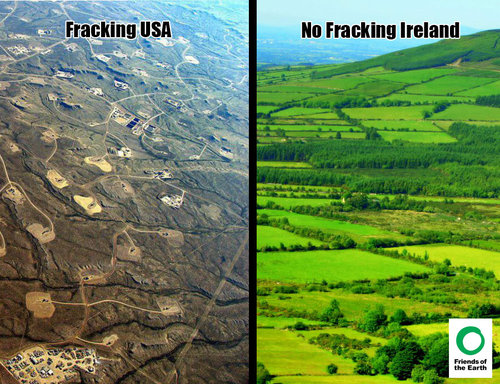
USA fracked landscape on left, with visible oil wells. Will parts of Irish country side look similar?

USA fracked landscape on left, with visible oil wells. Will parts of Irish country side look similar?

Increased flooding, extreme weather, rising fuel prices. The signs are all around of us of the need for a break from fossil fuels. We are told that Ireland could be the Saudia Arabia of the green energy world. Despite this, the Prime Time debate on Tuesday 11th March in relation to Oil and Gas exploration in Ireland did not once mention climate change. On the panel were Eddie Hobbs, Richard Boyd Barrett TD, Minister for Energy & Natural Resources Pat Rabbitte and David Horgan of Petrel Resources. The debate largely focused on what tax rate should be charged on any finds of oil and gas off the coast of Ireland. While this is indeed an important discussion to have, all sides seemed to agree that if reserves were found they should be exploited, with Pat Rabitte even questioning the sense of leaving it in the ground.

It is now recognised in climate science, that if we are to avoid the critical threshold of 2 degrees of warming we can only ‘afford’ to exploit one fifth of the world’s remaining fossil fuel reserves. Therefore, it would seem clear that the future of the planet and a stable climate would depend on resources being left in the ground and alternative, cleaner sources of energy being favoured.

Closer to home , the possibility of shale gas being exploited in the process of hydraulic fracturing or ‘fracking’ is being investigated in Counties Fermanagh, Leitrim & Cavan. If fracking were to be given the go ahead in these areas, this could result in significant environmental destruction of the area and pollution to the water table. At present.

In the Republic, the government has put in place a moratorium of the granting of new licenses for fracking, pending further studies.

Fracking involves drilling up to 2km below the surface to access shale gas trapped in rock. Water, chemicals and sand are pumped at high pressure under the rock to create cracks in the rock, to access the gas, which is then pumped up to the fracking wells on the surface.

According to Robert Emmet Hernan, author of The Borrowed Earth, Irish farmers should be deeply concerned about fracking. He cites the risk of groundwater and surface pollution from the chemicals used in fracking, dangers from trucks carrying chemicals and hazardous waste on country roads, as well as general threat to quality of life by greater industrialisation brought by fracking as concerns that farmers and rural dwellers alike should have. He also raises concerns about competition for water resources. Fracking requires between 2.4 to 7.8 million gallons of water per well, according to assessment in New York.

Fracking has caused controversy in the USA, with claims that leakages and poor regulation leading to high methane levels in water supplies, as well as issues around the disposal of the highly toxic waste materials. There has also been a link between fracking and seismic activity. An earthquake of magnitude 3.0 on the richter scale has been linked to fracking in Ohio.

With the upcoming local and European elections, Friends of the Earth are calling on people to prompt their candidates and public representatives about fracking to find out their stance on the issue.

Over all, there are many worrying issues that are still unclear about fracking. Above all else, if we are serious about combatting climate change and leaving a stable future for generations to come it is about time we start leaving the oil in the soil!

Potential of small biogas plants to produce energy and compost

We have a renewable energy source which is largely untapped in Ireland.  Anaerobic Digestion (AD) is a great story to tell.  It takes slurry and surplus agri waste as well as certain types of waste currently sent to landfill and turns it into renewable energy. It also produces an organic fertiliser. The technology is proven and widely used across Europe.  Here are some questions and answers about AD and its potential use in Ireland.

Continue reading

Developing Community Resilience

Co Monaghan was lucky to escape the worst effects of  last week’s storm that hit the whole country.  Developing community resilience is now regarded as important in helping deal with various types of emergencies that affect communities.

Floods at Lough Muckno

While we had a few fallen trees and slates from the recent storm, there was  unfortunately  the loss of of person’s life in the Midlands. For some people in other parts of Ireland there were power outages for a few days while others were left with no telephone or broadband services.   The utility companies and some local authority and emergency services staff had to come out in the adverse weather to respond to the urgent situations that had arisen.

So what happens if communities are faced with emergencies be they from a natural or manmade diaster.  A lot depends on the level of ‘community resilience’. ‘Cultivate’, the practical sustainability organisation, which is based in Cloughjordan, has been working on ways that community resilience can be developed.  Davie Philip of Cultivate defines community resilience as the capability of communities to hold together, learn, adapt and maintain their ability to function in response to change. These changes can be sudden or slowly evolving. Davie sees the biggest challenge being our mind-set. Most of us don’t realise that we are never more than three days from running out of food – except you might only have a few days extra in your cupboard.   Co-sufficiency rather than self-sufficiency is advocated. He sees the GIY (Grow it Yourself) movement and the increasing number of allotment projects as very welcome as they are examples of ways in which more people can have their own local food and also the skills to produce it – and so be more resilient. Developing community resilience can also be an enjoyable experience as people come together to share various skills and enjoy the fun and celebrations that form part of community projects.

The online UK book ‘Exploring Resilience in times of Rapid Change’ is a useful resource for communities looking at community resilience. It draws on the experience of emergency responses such as in the case of Hurricane Katrina in the US and explores the development of four key features of resilient communities: (1) healthy and engaged people. (2) an inclusive culture creating a positive sense of place.(3) a localising economy – towards sustainable food, shelter, housing shelter etc. (4) strong links to other places and communities.  In recent years the use of social media has also been found to be extremely useful in helping communities in emergency situations.

In emergencies, individuals and of course our national and local authorties also have  important roles to play. In a severe storm,  individuals and families can be without power for many days.  Heating and cooking become impossible or at least challenging for many of us. If we have a gas cooker or solid fuel stove (with no back boiler) it means we can boil some water. In order to be prepared for a storm it is advisable to have roof slates checked and also to a arrange for a professional assessment of tall trees that are near the house or roadside to see that  they are not likely to be blown down in a storm.  There are useful tips on tree safety in the ‘Roads / Severe Weather Information’ section of the  Cork Co Council website www.corkcoco.ie. Detailed guidance on flooding can be found at www.flooding.ie while  www.winterready.ie has useful guidance on dealing with adverse winter weather in the following contexts:  home, road safety, health matters, schools, farming community and businesses.  Businesses are directed to the Forfás document on ‘Business Continuity Planning in Severe Weather’.

The national authorities and volunteer support workers also play a major role in responding to emergencies. The website www.emergencyplanning.ie details the Irish Government’s plans for dealing with major emergencies. In the North East there is an inter-agency Regional Steering Group that has been formed for the Major Emergency Region of the North East.  Monaghan Co Council has details on emergency planning on its website (under Fire & Building Control Section) including the ‘Preparing for Major Emergencies handbook’. In relation to the threat of a nuclear incident the Radiological Protection Institute of Ireland’s website (www.rpii.ie) describes the National Plan for Nuclear Emergencies.

The ‘Emergency Planning Society’ (www.the–eps.org) is an international organisation of emergency planning professionals and it has a branch in Ireland.  Here in Ireland we also have our Civil Defence which in emergency situations supports Government agencies and the Emergency Services. It is a volunteer based organisation with 4,500 volunteers. For further details or to enquire about enrolling see www.civildefence.ie.

At various levels – be it at individual, family, community, business, local authority, national or international there is a need to have certain preparations in place to deal with emergencies. There are certain situations that we cannot prepare for. However there are ones, be they unexpected or slowly developing, that we can have certain strategies, plans, expertise, skills and resources in place to help our response ‘in the event of an emergency’.