Permaculture Course: June 2014

The beautiful Ballybay Wetlands Centre provided a very suitable location for a weekend of discussions and workshops on living sustainably. The sun shone on the drumlins surrounding the Dromore River, and the birds gently tweeted as Marella Fyffe, from Omagh Co. Tyrone, led Transition Monaghan’s weekend workshop on Sustainable Living Skills / Permaculture.

Participants of  the Permaculture Course at  the sunny Wetlands Centre

Continue reading

Learn ‘sustainable living’ skills at upcoming ‘permaculture’ course in Ballybay Wetlands Centre


Image

Marella Fyffe will lead next month’s permaculture course to be held at Ballybay Wetlands Centre.

 Permaculture has been described as a philosophy of design – blending our food, shelter, & lifestyle requirements with natural processes or in other words working with nature to achieve sustainability. Monaghan Ecological Group is organising a two day ‘Introduction to Permaculture’ course at Ballybay Wetlands Centre on Saturday and Sunday , 14 to 15 June. 

Click here to book.

The course will be led by Marella Fyffe who trained as a permaculture teacher with Designed Visions in the UK. Marella also teaches organic gardening in community schools and colleges around Omagh and Northern Ireland. She previously lectured at the Organic Centre in Leitrim and also South West College in Omagh and Enniskillen and she brings a wealth of creative experiential teaching to any group she works with. Marella says that the course will introduce participants to the basics of permaculture design and inspire and empower them to apply permaculture design to their lives. She aims to develop in participants a very deep awareness of the earth and the importance of Nature. There will be a practical element including time spent outside in Nature during which those attending will co-create a design over the two-day course.

 Marella explains that the course takes into consideration that we live in a world of finite resources with infinite possibilities. During the course the group will look at the challenges and opportunities and create some local solutions that will make a difference in our world now and for future generations.  It is open to anyone aged 16 or over to attend and no prior knowledge of permaculture is needed. The course will be taught using a variety of methods; group work, games, presentations, discussion, video and slides.  By the end of the course, participants will have a basic knowledge of some of the permaculture ethics and principles and how to apply them.  Marella says that it is an ideal starter for anyone interested in a full permaculture design course.

 The course is part funded by Monaghan County Council’s Local Agenda 21 Environment Partnership Fund. The fee for participants is €20 plus booking fee.

Lights out for Earth Hour Saturday at 8:30pm

Solidarity for those affected by Climate Change this Earth Hour

Solidarity for those affected by Climate Change this Earth Hour

Earth Hour is a global WWF (formerly known as World Wildlife Fund) climate change initiative. It’s an event that aims to create awareness of the need for us to take responsibility to ensure a sustainable future.  In a global symbolic act, many people turn off their non-essential lights for the hour from 8:30 to 9:30pm local time.  Some people enjoy Earth Hour with a candle-lit dinner or a party.  Earth Hour started off as a lights-off event in Sydney in 2007. Since then it has grown to engage more than 7000 cities and towns worldwide.

The interchurch organisation ‘Eco-congregation Ireland’ suggests ‘’a special candle-lit service with ‘care for creation’ as the theme, or a silent prayer vigil to remember all the species (animal, bird, plant & fish) that have become extinct as a result of human’s actions.’’  Alternatively, they suggest hosting ‘’a LOAF meal using Locally-produced, Organically-grown, Animal-friendly and Fairly-traded ingredients or even just a get-together with Fairtrade refreshments and perhaps include some star-gazing.’’

Arrival of the Swallows

I spotted two swallows flying over Castleblayney on Sunday last (23 March). Swallows are now arriving much earlier than in the 1980s and this trend is being attributed to climate change. However if the weather over the next few weeks turns cold, some of this year’s early arriving swallows may perish.

Recording the arrival of Spring in Ireland is of particular interest to Primary school pupils, many of whom log their sightings of six species at www.greenwave.ie. In the process they help fulfill the award of ‘Science and Maths Excellence’. Across Europe many children and adults record sightings of certain migrating birds at www.springalive.net.

Oil & Gas Debate: Where do our priorities lie?

The current dispute between Russia and the Ukraine has once again drawn attention to  the dependency of Europe on gas from Russia. Nowhere is this more relevant than Ireland, where we import roughly 90% of our fossil fuels. Mícheál Callaghan went along to a recent Prime Time debate on Oil & Gas exploration in Ireland.

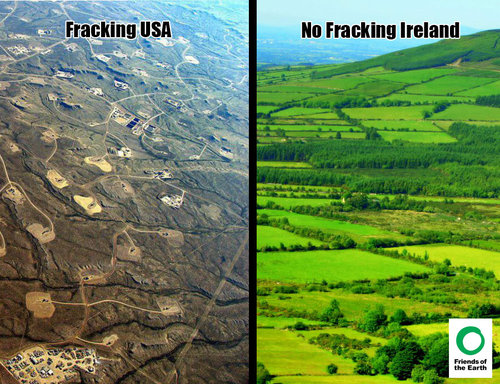
USA fracked landscape on left, with visible oil wells. Will parts of Irish country side look similar?

USA fracked landscape on left, with visible oil wells. Will parts of Irish country side look similar?

Increased flooding, extreme weather, rising fuel prices. The signs are all around of us of the need for a break from fossil fuels. We are told that Ireland could be the Saudia Arabia of the green energy world. Despite this, the Prime Time debate on Tuesday 11th March in relation to Oil and Gas exploration in Ireland did not once mention climate change. On the panel were Eddie Hobbs, Richard Boyd Barrett TD, Minister for Energy & Natural Resources Pat Rabbitte and David Horgan of Petrel Resources. The debate largely focused on what tax rate should be charged on any finds of oil and gas off the coast of Ireland. While this is indeed an important discussion to have, all sides seemed to agree that if reserves were found they should be exploited, with Pat Rabitte even questioning the sense of leaving it in the ground.

It is now recognised in climate science, that if we are to avoid the critical threshold of 2 degrees of warming we can only ‘afford’ to exploit one fifth of the world’s remaining fossil fuel reserves. Therefore, it would seem clear that the future of the planet and a stable climate would depend on resources being left in the ground and alternative, cleaner sources of energy being favoured.

Closer to home , the possibility of shale gas being exploited in the process of hydraulic fracturing or ‘fracking’ is being investigated in Counties Fermanagh, Leitrim & Cavan. If fracking were to be given the go ahead in these areas, this could result in significant environmental destruction of the area and pollution to the water table. At present.

In the Republic, the government has put in place a moratorium of the granting of new licenses for fracking, pending further studies.

Fracking involves drilling up to 2km below the surface to access shale gas trapped in rock. Water, chemicals and sand are pumped at high pressure under the rock to create cracks in the rock, to access the gas, which is then pumped up to the fracking wells on the surface.

According to Robert Emmet Hernan, author of The Borrowed Earth, Irish farmers should be deeply concerned about fracking. He cites the risk of groundwater and surface pollution from the chemicals used in fracking, dangers from trucks carrying chemicals and hazardous waste on country roads, as well as general threat to quality of life by greater industrialisation brought by fracking as concerns that farmers and rural dwellers alike should have. He also raises concerns about competition for water resources. Fracking requires between 2.4 to 7.8 million gallons of water per well, according to assessment in New York.

Fracking has caused controversy in the USA, with claims that leakages and poor regulation leading to high methane levels in water supplies, as well as issues around the disposal of the highly toxic waste materials. There has also been a link between fracking and seismic activity. An earthquake of magnitude 3.0 on the richter scale has been linked to fracking in Ohio.

With the upcoming local and European elections, Friends of the Earth are calling on people to prompt their candidates and public representatives about fracking to find out their stance on the issue.

Over all, there are many worrying issues that are still unclear about fracking. Above all else, if we are serious about combatting climate change and leaving a stable future for generations to come it is about time we start leaving the oil in the soil!

Potential of small biogas plants to produce energy and compost

We have a renewable energy source which is largely untapped in Ireland.  Anaerobic Digestion (AD) is a great story to tell.  It takes slurry and surplus agri waste as well as certain types of waste currently sent to landfill and turns it into renewable energy. It also produces an organic fertiliser. The technology is proven and widely used across Europe.  Here are some questions and answers about AD and its potential use in Ireland.

Continue reading

Developing Community Resilience

Co Monaghan was lucky to escape the worst effects of  last week’s storm that hit the whole country.  Developing community resilience is now regarded as important in helping deal with various types of emergencies that affect communities.

Floods at Lough Muckno

While we had a few fallen trees and slates from the recent storm, there was  unfortunately  the loss of of person’s life in the Midlands. For some people in other parts of Ireland there were power outages for a few days while others were left with no telephone or broadband services.   The utility companies and some local authority and emergency services staff had to come out in the adverse weather to respond to the urgent situations that had arisen.

So what happens if communities are faced with emergencies be they from a natural or manmade diaster.  A lot depends on the level of ‘community resilience’. ‘Cultivate’, the practical sustainability organisation, which is based in Cloughjordan, has been working on ways that community resilience can be developed.  Davie Philip of Cultivate defines community resilience as the capability of communities to hold together, learn, adapt and maintain their ability to function in response to change. These changes can be sudden or slowly evolving. Davie sees the biggest challenge being our mind-set. Most of us don’t realise that we are never more than three days from running out of food – except you might only have a few days extra in your cupboard.   Co-sufficiency rather than self-sufficiency is advocated. He sees the GIY (Grow it Yourself) movement and the increasing number of allotment projects as very welcome as they are examples of ways in which more people can have their own local food and also the skills to produce it – and so be more resilient. Developing community resilience can also be an enjoyable experience as people come together to share various skills and enjoy the fun and celebrations that form part of community projects.

The online UK book ‘Exploring Resilience in times of Rapid Change’ is a useful resource for communities looking at community resilience. It draws on the experience of emergency responses such as in the case of Hurricane Katrina in the US and explores the development of four key features of resilient communities: (1) healthy and engaged people. (2) an inclusive culture creating a positive sense of place.(3) a localising economy – towards sustainable food, shelter, housing shelter etc. (4) strong links to other places and communities.  In recent years the use of social media has also been found to be extremely useful in helping communities in emergency situations.

In emergencies, individuals and of course our national and local authorties also have  important roles to play. In a severe storm,  individuals and families can be without power for many days.  Heating and cooking become impossible or at least challenging for many of us. If we have a gas cooker or solid fuel stove (with no back boiler) it means we can boil some water. In order to be prepared for a storm it is advisable to have roof slates checked and also to a arrange for a professional assessment of tall trees that are near the house or roadside to see that  they are not likely to be blown down in a storm.  There are useful tips on tree safety in the ‘Roads / Severe Weather Information’ section of the  Cork Co Council website www.corkcoco.ie. Detailed guidance on flooding can be found at www.flooding.ie while  www.winterready.ie has useful guidance on dealing with adverse winter weather in the following contexts:  home, road safety, health matters, schools, farming community and businesses.  Businesses are directed to the Forfás document on ‘Business Continuity Planning in Severe Weather’.

The national authorities and volunteer support workers also play a major role in responding to emergencies. The website www.emergencyplanning.ie details the Irish Government’s plans for dealing with major emergencies. In the North East there is an inter-agency Regional Steering Group that has been formed for the Major Emergency Region of the North East.  Monaghan Co Council has details on emergency planning on its website (under Fire & Building Control Section) including the ‘Preparing for Major Emergencies handbook’. In relation to the threat of a nuclear incident the Radiological Protection Institute of Ireland’s website (www.rpii.ie) describes the National Plan for Nuclear Emergencies.

The ‘Emergency Planning Society’ (www.the–eps.org) is an international organisation of emergency planning professionals and it has a branch in Ireland.  Here in Ireland we also have our Civil Defence which in emergency situations supports Government agencies and the Emergency Services. It is a volunteer based organisation with 4,500 volunteers. For further details or to enquire about enrolling see www.civildefence.ie.

At various levels – be it at individual, family, community, business, local authority, national or international there is a need to have certain preparations in place to deal with emergencies. There are certain situations that we cannot prepare for. However there are ones, be they unexpected or slowly developing, that we can have certain strategies, plans, expertise, skills and resources in place to help our response ‘in the event of an emergency’.

Climate Justice Begins at Home

MEG member Liam Murtagh went along recently to a special seminar entitled ‘Climate Justice begins at Home’ – an event held to coincide with the Mary Robinson Foundation’s international conference in Dublin, ‘Hunger – Nutrition – Climate Justice 2013’   The seminar was organised by Friends of the Earth and Food Sovereignty Ireland.    

FOE

Cecilia Kibe from Kenya was just one of the many grassroots community members from the developing world who had travelled to the Dublin conference to represent their communities.  The conference aimed to focus the eyes of the world and in particular the attention of decision makers on the injustice of climate change – a situation in which the people who have not caused climate change are the ones who are suffering the most from its effects. At the seminar Cecilia described how climate change is being primarily caused by the burning of fossil coal and oil in the developed world and that it is setting back the efforts to address the Millenium Development Goals in the developing world. She outlined the impact of droughts on food production in East Africa and also the effects of land erosion which happens in certain areas when there are downpours following long periods of drought.

Continue reading

Chasing Ice – Film Screening Nov 2013

On Thursday 6 November 2013, Monaghan Ecological Group hosted a free film screening of “Chasing Ice” in the Market House, Monaghan, at 7:30pm.

Chasing Ice is a compelling film which charts the work of photographer James Balog, who began tracking changes in Arctic Ice in 2005, by placing a number of cameras at different locations across the arctic. Through photographs and videos, Balog built up spectacular time lapse images and videos of changes to arctic sea ice, including the capturing of dramatic ice cavings, when large chunks of ice break off into the sea. The result is indisputable evidence of the dramatic pace of arcitc ice melt in recent years. The film provides moving and compelling evidence of man made climate change.

The evidence is in the ice!

Local Woodlands & Tropical Forests – Life Supports for Humanity

Earlier this month a book entitled ‘A walk in the Park’ was launched at Ballybay Wetlands Centre. The book was compiled by participants on Monaghan Community Forum’s ‘Hands Together 2’ PEACE III Project’ and focused on the value of the trees and plants we have in the parks of Co Monaghan.  Andrew St Ledger of the ‘Woodland League’, who launched the book, is an enthusiastic promoter of native woodlands.  

Liam Murtagh, a project participant and also a member of Monaghan Ecological Group went along to the launch. He now reflects on why, for the sake of future generations, we should stop buying tropical hardwoods and do what we can to ensure that more native trees are grown in Ireland. Both actions he says will help improve biodiversity and reduce greenhouse gas emissions.

Andrew St Ledger of the ‘Woodland League’ pictured at the entrance to Ballybay Wetlands Centre as he spoke about the merits of the Aspen tree, while leading a walk around the grounds of the Centre.

Andrew St Ledger of the ‘Woodland League’ pictured at the entrance to Ballybay Wetlands Centre as he spoke about the merits of the Aspen tree, while leading a walk around the grounds of the Centre.

Just imagine what the landscape of Co Monaghan was like ten centuries ago when there was complete tree cover, with the oak as the prime tree of the forest. This was the image that Andrew St Ledger described as he commenced a really interesting guided walk around the lands surrounding the Ballybay Wetlands Centre.  He began by emphasising the enormous global importance of trees as well as the value of local trees in the fields around the Centre both now and in the past. The economy of the Gaelic Order was that of the forests,  providing raw materials as well as the basis for spirituality and wisdom. The mystical Ogham alphabet corresponds to the first letter of each of our native trees.

Today it is gradually being realised again that trees are of enormous benefit to humanity, and being the ‘lungs’ of the planet they  provide  a range of what are now termed ‘ecosystem services’. These include oxygen, carbon storage, biodiversity value and many more benefits. Research now tells us that trees are extremely advanced in terms of their DNA and that they ‘communicate’ complex chemical messages to other trees and living things. Some trees, as well as taking up water, even ‘spraying’ an invisible mist to help give their neighbouring plants some moisture during dry spells. As we walked around the Wetlands Centre we saw some oaks that are about 200 hundreds years old. Oaks can live for 1000 years and are particularly rich in biodiversity value.

Ireland now has the second lowest area of tree cover in Europe – only 10% of the land area of Ireland is under forest. The Government has a target of 17% but it is unlikely if it will be reached anytime soon. Most of the forestry in Ireland is made up of monocultural conifer plantations of trees like Sitka Spruce.   While they are beneficial for certain timber uses and as a carbon sink they are considered very poor in biodiversity value. It is also claimed that they have contributed to pollution of water due to acidification and other effects.

As we have not been growing enough hardwood trees in Ireland, we are importing tropical hardwoods in the form of flooring and other timber products. While they are supposed to come from ‘sustainably managed forests’ the reality is that much of this timber is still illegally logged. The American scientist O A Wilson once said: “Destroying rainforest for economic gain is like burning a Renaissance painting to cook a meal.” In Ireland, the organisation ‘Just Forests’ campaigns against the sale of illegally logged tropical hardwood. They encourage us when buying timber from a DIY or a builders’ provider to check that it is marked ‘FSC (Forest Stewardship Council) certified’.

Andrew St Ledger is eager to see plantations in Ireland, which economists consider non-viable, instead providing training opportunities in tree harvesting as well as fuel and timber products for local communities. As the trees are felled we could plant other trees that are suitable for coppicing for firewood and other uses. He is particularly keen that we plant more native trees. Ash is a tree that has been used for furniture making and hurleys as well as being coppiced for firewood. However the recent arrival of ash dieback disease means that other native species such as hazel, willow, cherry, oak and alder need to be considered as alternatives to ash.  Ongoing financial supports are needed to incentivise landowners and farmers to planting hardwood.  Agroforestry, which involves trees growing on the same land with livestock or arable crops is an alternative system of land use that would, if viable and widely adopted,   help increase the number of trees being planted.

In recent years many schools have developed schools gardens. Andrew says that schools could also develop small native tree nurseries. This can begin at this time of year with the collecting of seeds such as acorns and planting them in beds within the school garden.  From there they can be lifted in a few years and planted in their permanent location, e.g. in a common green area within the community.

It’s coming to the time of year that we can do some tree planting. If you or an organisation you belong to, wish to plant native trees, you can obtain large quantities from sources such as www.nonesohardy.ie or smaller quantities from www.futureforests.net.  In previous years Monaghan Co Council supplied a limited quantity of tree plants to community groups for Tree Week in March.  If you wish to find out more about any of many national organisations that are involved in various aspects of forestry see  www.forestryfocus.ie/governance/organisations for details.

Local Exchange Trading Scheme to Boost Local Trade & Resilience

Local Exchange Trading Scheme to Boost Local Trade & Resilience

 
Monaghan Ecological Group is working with local organisation, LETS TRADA to develop a Local Exchange Trading Scheme in Clones. Such a scheme would encourage local trade, keep people in work and contribute to building a resilient community. Mícheál Callaghan in discussion with Ciarán Fitzpatrick examines how this scheme will work and the benefits that it will bring to the Clones area.
 
Image The new logo for LETS Trada, Local Exchange Trading Scheme


Continue reading